


 Top Rated Course

We may not have the course you’re looking for. If you enquire or give us a call on +44 1344 203 999 and speak to our training experts, we may still be able to help with your training requirements.
Marketing Research Process: A Step-by-Step Guide
James Smith 27 April 2026The Marketing Research Process involves defining the problem, developing a research plan, collecting and analysing data, and using insights to make decisions. It helps understand customer needs, market trends, and improve overall marketing strategies. Ultimately, it supports better business planning and long-term growth.

Training Outcomes Within Your Budget!
We ensure quality, budget-alignment, and timely delivery by our expert instructors.
Table of Contents
Making smart business decisions isn’t just about guessing; it’s about using the right information. That’s where Market Research comes in. It helps businesses understand what customers want, spot trends, and keep up with competitors.
Learning how to do Market Research can make a big difference. In this blog, we’ll explain What is the Market Research Process, the steps of the Marketing Research Process, the different types of research, and how they can help your business grow. Let’s get straight into it!
Table of Contents
1) The Process of Marketing Research
2) Types of Marketing Research
3) Market Research Examples
4) What is the Main Idea of Marketing Research?
5) What are the Four Main Purposes of Market Research?
6) Conclusion
The Process of Marketing Research
The Marketing Research Process represents a systematic and scientific approach to the collection, analysis, and interpretation of data concerning a specific market, product, or service. This process highlights the Benefits of Market Research, as it enables businesses to accurately understand their Target Audience and refine their strategies for success.
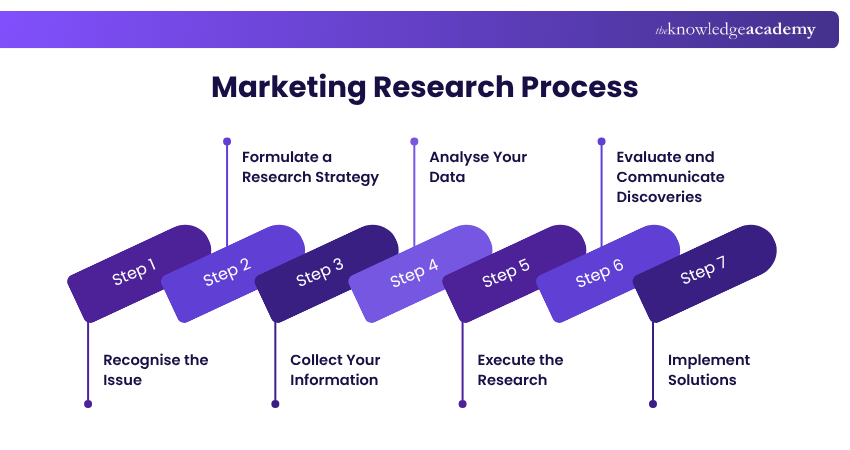
This procedure assists businesses in comprehending and fulfilling customer needs, thereby securing a Competitive Advantage within the marketplace. The Marketing Research Process involves the following five main steps:
1) Recognise the Issue
The first step in Marketing Research is to clearly identify the problem you need to solve. Start by stating the business challenge and what information you need to find a solution. Then, set clear research goals such as what do you want to learn by the end of the research? What insights or recommendations will help make the research valuable.
Share the problem and research goals with your team to get feedback and refine your focus. Sometimes, the real issue isn’t what it seems at first. Collaborating with others helps you understand the problem better and decide what’s most important to explore, especially if time and resources are limited.
To dig deeper, start brainstorming key research questions. What answers do you need? What missing information will research help you find? This step helps set the direction for your research, figure out who to talk to, and identify what information is already available and what still needs to be gathered.
Applied Example: Marketing Research for Bella’s Café
Bella owns a small café, but business is slowing down. She wants to know how to bring in more customers and make more sales. Marketing Research will help her find answers.
Identifying the Problem, Goals, and Questions
a) Main problem: How can Bella’s café attract more customers and boost profits?
Research Goals
a) Find out who Bella’s regular customers are.
b) Discover what new customers would like to see on the menu.
Key Research Questions
a) Who visits Bella’s café, and how often?
b) What are the best-selling menu items?
c) What food or drinks do customers want?
d) Why do people choose Bella’s café over others?
e) Why are some people not visiting the café?
By asking the right questions, Bella can make smart changes to improve her business!

2) Formulate a Research Strategy
Once you’ve defined the problem, set research objectives, and created initial questions, the next step is to make a research plan. This involves identifying the information you need, like customer opinions, behaviours, sales data, or competitor insights. Consider your timeline, budget, and resources as you plan.
The research plan also outlines how you’ll collect and analyse data. Simple research needs basic methods, while complex designs may require more time, money, and expertise. The plan also specifies who will handle data collection, analysis, and reporting. This could be an in-house team or an external agency.
Finally, decide how the findings will be shared. Tailor reports to your audience, often senior leaders, and get their input on the plan to ensure buy-in and alignment with business goals.
Applied Example: A Bookends Research Plan
After discussing the challenges with Bella, she agrees that understanding her customers better is key to growing her café. The next step is to create a research plan to gather useful information and find ways to attract more customers. However, Bella has a limited budget, so the plan needs to be affordable yet effective.
Step 1: Identifying Data Types
Types of Data Needed:
a) Customer demographics and preferences (age, lifestyle, food choices).
b) Spending patterns of current customers.
c) Local area demographics to identify potential new customers.
Step 2: Timing & Budget
a) Timeline: Complete research within one month.
b) Budget: Minimal or no extra costs.
Enhance your Content Marketing skills with our Content Marketing Course – Sign up now!
3) Collect Your Information
At this stage, data is gathered using the methods defined in the research plan. This step focuses on collecting accurate, relevant, and unbiased information that directly addresses the research questions. The quality of data collected here plays a crucial role in determining how reliable and useful the final insights will be.
Businesses can collect primary data, which is gathered firsthand through surveys, interviews, observations, or focus groups, allowing for more specific and tailored insights. They can also use secondary data, such as industry reports, sales records, competitor analysis, and online reviews, which helps save time and provides a broader context.
Applied Example: Gathering Customer Insights for Bella’s Café
Now, Bella needs to find ways to collect the required information. She can carry out the following actions for that:
a) Share Surveys on Social Media and Through WhatsApp Groups
Bella can create simple surveys using tools like Google Forms and share them across Instagram, Facebook, and local WhatsApp groups. This helps her reach a wider audience quickly, including both existing and potential customers.
b) Conduct Short Interviews With Customers During Peak and Non-peak Hours
By speaking directly with customers at different times of the day, Bella can understand varied customer behaviours and preferences. These conversations provide deeper insights that surveys alone may not capture.
c) Review Online Ratings and Comments on Social Media Platforms
Checking online reviews allows Bella to see honest customer opinions about her café. Positive feedback highlights strengths, while negative comments reveal areas that need improvement.
d) Gather Sales Data to Identify Popular Items and Slow-moving Products
Analysing past sales records helps Bella understand which menu items perform well and which do not. This data gives clear, factual insights into customer purchasing patterns.
4) Analyse Your Data
After collecting the data, the next step is to organise and study it carefully. The information is sorted into clear groups, such as customer behaviour, preferences, and sales trends, so it becomes easier to understand and compare.
Businesses then look for patterns and trends, such as which products are most popular, when customers visit the most, or what common feedback is being shared. This helps highlight both strengths and problem areas. Tools like charts, tables, or simple summaries can be used to make the data clearer and more visual.
Applied Example: Turning Customer Data into Clear Insights
Before making any decisions, Bella needs to carefully analyse the data she has collected to understand what it really means for her café. Here’s how she breaks down and understands her data:
a) Identify Patterns in Customer Visits
Bella can check when most customers visit her café, like on weekends or on weekdays. This helps her understand busy and slow days, so she can plan staff, stock, and offers accordingly.
b) Analyse Best-selling and Least-selling Menu Items
She can look at which items are ordered the most and which are rarely chosen. This helps her keep popular items and improve or remove the ones that are not performing well.
c) Group Customer Preferences
Bella can organise feedback based on what customers want, such as healthier choices, budget-friendly meals, or new flavours. This makes it easier to update the menu based on real demand.
d) Identify Common Complaints
By reviewing feedback, she can spot repeated issues such as pricing, menu variety, or service speed. If many customers mention the same problem, it clearly shows what needs improvement.
e) Compare Feedback From Regular vs New Customers
Bella can separate feedback from loyal customers and first-time visitors. This helps her understand what keeps people coming back and what may stop new customers from returning.
5) Execute the Research
Research can be an exciting part of marketing. At first, you might feel stuck because of gaps in your knowledge, but research helps answer key questions and gives you valuable insights.
Start with secondary research using existing reports, surveys, or company data. These sources are usually cheaper and can provide helpful background information. Even if they don’t fully answer your questions, they can give you a better understanding of the problem.
If needed, move to primary research. This means gathering new data by asking questions, running surveys, or observing customers. To get accurate results, use proper research methods, choose the right audience, and ask clear questions.
Poor research methods can lead to bad data or biased results, which can mislead your decisions. Using the right techniques ensures reliable insights that guide your marketing strategy.
6) Evaluate and Communicate Discoveries
After collecting survey data, the next step is turning it into useful insights that answer key questions. This information is usually shared with managers through a presentation or report.
The process starts with organising and cleaning the data to ensure accuracy. Then, data is analysed to reveal key trends, like customer opinions, buying habits, or revenue patterns. Different techniques help, such as:
a) Regression Analysis: Finding relationships between factors.
b) Conjoint Analysis: Understanding trade-offs and preferences.
c) Predictive Modelling: Spotting trends and future patterns.
d) Social Media and Search Analysis: Understanding what people say and do online.
Good analysis is important because it helps businesses understand what the data means and what actions to take. For example:
a) What are the key takeaways managers should know?
b) Which market segments should we focus on?
c) Why do customers choose competitors, and how can we improve?
Experts who understand the business should help interpret the findings, as they can provide the best insights and recommendations.
The final report may be a presentation or a detailed document, depending on company preferences. Presentations work well for quick insights, while written reports provide deeper details for future reference.
Optimise your success formula – Join our Marketing Budget Course and gain the expertise to maximise impact with strategic financial planning.
7) Implement Solutions
Many think a Marketing Research project ends once the report is done and recommendations are shared. But the most important step comes with taking necessary action. If the research supports the company’s current path, it can motivate the team to push forward. However, when findings suggest a new direction, leaders need time to understand the insights, plan strategies, and allocate resources.
Many research projects fail because reports are too technical, lack clear insights, or don’t offer actionable steps. To avoid this, research should stay focused on business goals, and findings should be easy to understand. A well-explained report helps managers use the data to make informed decisions, adjust strategies, and drive success.
Begin your marketing adventure with confidence – Join our Introduction to Marketing Training today!
Types of Marketing Research
When planning your research, you’ll use one or more types of Marketing Research. Each type helps you collect, analyse, and present solutions to problems your audience faces. There are four main types of Marketing Research:

1) Exploratory Research
Got a new idea that hasn’t been explored before? Exploratory research helps gather information about a problem and possible solutions. It relies on existing data to provide insights.
As you research, stay open to new findings. Your data might lead you to adjust your research question or look at the problem differently. The goal is to collect as much useful information as possible, and not to prove a solution right away.
2) Descriptive Research
This type of research tests whether your research question is correct or not. It helps measure how often something happens and how different factors are connected.
If you want to know who would buy your product, how it’s used, or who your competitors are, this method works well. You can gather data through surveys, interviews, or observations. However, if the researcher records responses instead of the participant, personal bias might affect the results. To ensure accuracy and clarity in your approach, understanding How to Write Research Methodology is essential for structuring your research and minimising bias.
3) Causal Research
Causal research looks at cause-and-effect relationships. It tests how changing one thing impacts another. For example, what happens if you change your product’s price or packaging? This method allows for repeat testing, making it reliable. However, sometimes things may appear connected when they’re actually just coincidences. Also, if two factors are closely related, it can be hard to tell which one causes the effect.
4) Predictive Research
Predictive research helps businesses forecast the future. It looks at things like future sales, customer demand, and market trends based on current data. It often uses demographic data, customer preferences, and Big Data to predict trends. This helps businesses decide where to invest time and money for the best results.
Elevate your skills to dominate the market. Join our Marketing Courses now and become a marketing maestro.
Market Research Examples
Market Research can be applied in many practical ways to help businesses make better decisions. Below are some common examples of how organisations use it in real situations:
1) Measuring Customer Satisfaction
Businesses use Market Research Process to understand how satisfied their customers are with their products or services. This is done through surveys, feedback forms, or reviews. By analysing this feedback, companies can identify what customers like, what problems they face, and where improvements are needed. This helps in building better customer experiences and increasing loyalty.
2) Evaluating the Competition
Market Research helps businesses understand their competitors’ strengths and weaknesses. This includes analysing their pricing, products, marketing strategies, and customer reviews. By doing this, companies can identify gaps in the market and find ways to stand out. It also helps them stay competitive and make smarter strategic decisions.
3) Improving New Products
Before launching a new product, businesses often conduct research to test ideas and gather customer opinions. This can include product testing, surveys, or focus groups. This helps companies understand what customers expect, what features they prefer, and whether the product meets their needs. As a result, they can make improvements before the final launch.
4) Evaluating Advertising and Marketing Campaigns
Market Research is used to measure how effective marketing campaigns are. Businesses can track metrics like customer engagement, brand awareness, and sales impact. By analysing these results, companies can understand what works and what doesn’t. This allows them to improve future campaigns and use their marketing budget more effectively.
Gain knowledge of how to implement an integrated marketing strategy with our Integrated Marketing Training – Join now!
What is the Main Idea of Marketing Research?
Marketing Research helps businesses understand their customers, market trends, and competition. By using Market Research Tools and Platforms, companies can collect valuable data to make informed decisions. This process reduces risks, improves products, and helps businesses grow. By knowing what people want, companies can create better marketing strategies and stay ahead of competitors.
What are the Four Main Purposes of Market Research?
The four main purposes of Market Research Process include:
a) Understand Customers: Learn what people need and want
b) Analyse Competition: See what others are doing
c) Improve Products: Use feedback to make better offers
d) Make Smart Decisions: Reduce risks and plan better strategies
Conclusion
The Marketing Research Process is vital for any business that wants to understand and satisfy its customers and gain a competitive edge in the market. In the initial stages, utilising Market Research tools will streamline your workflow. It involves steps like recognising the issue, formulating a research strategy, executing the research, evaluating and communicating discoveries, and implementing solutions. This goes with various Types of Marketing approaches used at each stage to enhance results.
Decode market trends and master the art of strategic decision-making with our Strategic Marketing Course – Sign up today!
Frequently Asked Questions
How Does Marketing Research Help in Business Growth?

Marketing Research helps businesses grow by understanding what customers want and need. It identifies market trends and new opportunities, allowing you to make smart decisions. With these insights, you can improve your products, target your marketing better, and stay ahead of competitors. This leads to more sales and happier customers
How Often Should Businesses Conduct Marketing Research?
Businesses should do Marketing Research on a regular basis. A good rule is to conduct it at least once a year or whenever there are big changes in the market. Regular research helps you keep up with trends, understand your customers, and watch your competitors. This way, you can make timely decisions and keep your business growing.
What are the Other Resources and Offers Provided by The Knowledge Academy?
The Knowledge Academy takes global learning to new heights, offering over 3,000+ online courses across 490+ locations in 190+ countries. This expansive reach ensures accessibility and convenience for learners worldwide.
Alongside our diverse Online Course Catalogue, encompassing 17 major categories, we go the extra mile by providing a plethora of free educational Online Resources like Blogs, eBooks, Interview Questions and Videos. Tailoring learning experiences further, professionals can unlock greater value through a wide range of special discounts, seasonal deals, and Exclusive Offers.
What is The Knowledge Pass, and How Does it Work?
The Knowledge Academy’s Knowledge Pass, a prepaid voucher, adds another layer of flexibility, allowing course bookings over a 12-month period. Join us on a journey where education knows no bounds.
What are the Related Courses and Blogs Provided by The Knowledge Academy?
The Knowledge Academy offers various Marketing Courses, including Marketing Research Training, Marketing Budget Course and Business Marketing Strategies Training. These courses cater to different skill levels, providing comprehensive insights into Brand Management.
Our Digital Marketing Blogs cover a range of topics related to the Marketing Research Process, offering valuable resources, best practices, and industry insights. Whether you are a beginner or looking to advance your Digital Marketing skills, The Knowledge Academy's diverse courses and informative blogs have got you covered.

James Smith


Digital Marketing Manager and Trainer
James Smith is a digital marketing professional with over a decade of experience in SEO, content strategy, paid media and analytics. He has supported both SMEs and global brands in transforming their digital presence. James’s writing and training are rooted in results-driven tactics and the latest marketing trends.
View Detail
Upcoming Digital Marketing Resources Batches & Dates
Date
 Marketing Research Training
Marketing Research Training
Thu 27th Aug 2026
Marketing Research Training
Thu 26th Nov 2026

 If you wish to make any changes to your course, please


