


 Top Rated Course

We may not have the course you’re looking for. If you enquire or give us a call on +44 1344 203 999 and speak to our training experts, we may still be able to help with your training requirements.
16 Essential Features of Python for Modern Software Development
The Knowledge Academy 14 July 2026Python is a readable, open-source language with great scalability and a rich standard library, ideal for web development, automation, data science, and AI. It supports rapid prototyping and works well with modern tools as well. Its versatility makes it useful for both beginners and experienced professionals.

Training Outcomes Within Your Budget!
We ensure quality, budget-alignment, and timely delivery by our expert instructors.
Table of Contents

Python is a universally acknowledged programming language because of its simplicity, flexibility, and applicability in many real-world scenarios. Python's design is such that it encourages quick learning for the novices but still assures the power for the experts. One gains a solid base for further discussions on the subjects presented in this blog by comprehending the main Features of Python.
Table of Contents
1) What is Python?
2) 16 Key Features of Python
3) How does Python Handle Memory Management?
4) How does Python Compare to JavaScript for Beginners?
5) Conclusion
What is Python?
Python is a high-level, object-oriented programming language that was designed to be simple, readable, and efficient for both beginners and experienced developers. It allows multiple programming paradigms and so is extensively used for making applications in different fields.
Among its features, Python has a very rich standard library and a lot of built-in modules that help to save time and minimise tasks associated with development. Python, backed by a strong community, cross-platform compatibility and the many advantages it provides, is one of the most popular languages in modern software development

Features of Python
Let us look at some of the Key Features of Python that make it popular among other programming languages.
1) Easy to Learn
The syntax of Python is simple and clear, which greatly benefits novices, as they are able to learn fast and solve problems instead of being bothered by the complexities of the rules. The user's comfort with Python makes it possible to develop skills quickly and get the learners ready for actual projects, along with the technical interviews.
2) Free and Open Source
Python can be freely downloaded, used, and distributed. It can also be modified by anyone who has access to its openly available source code. The open-source nature of Python promotes significant community support, ongoing enhancements, and a variety of libraries that are shared among developers.
3) High-level Language
The high-level nature of Python hides the low-level details, allowing programmers to concentrate on the development of clear logic and problem-solving instead. Built-in functions and data structures facilitate the handling of complex tasks and support the efficient development of applications.
4) Python is a Portable Language
Python is a language that can be used anywhere; it means that the programs that are written in it on one system can easily run on very different ones, like Windows, macOS, or Linux, with only slight changes.
5) Interpreted Nature
Being an interpreted language, Python executes its code line by line and offers instant feedback that speeds up testing and debugging. Such interactive execution is a boon for agile development and permits developers to play around, perfect, and fix their code in an effective manner.
6) Cross-platform Compatibility
Python’s compatibility across platforms allows the same code to run on Windows, macOS, and Linux with just a few alterations, thus delivering uniform performance. This means no more different codebases and also helps create applications targeting a much larger audience.
7) Object-Oriented Paradigm
Object-oriented programming is supported by Python, which allows developers to create modular and reusable code by classifying data + methods into objects. Inheritance + polymorphism, + encapsulation as features under Python make the management of complex systems easier and the maintainability of code better.
8) Dynamically Typed
Due to the dynamic typing of Python, it is not necessary for variables to be explicitly declared with a type, and at different times they can hold different types. This power of coding speeds up prototyping and iterative development, thus allowing easy and quick adjustment of code to meet changing project requirements.
9) Extensive Standard Library
Python has a very extensive standard library that is full of pre-built modules for all kinds of tasks, such as data processing, communication, file management, and multi-tasking, which makes the overall development process easier. Moreover, these tools that are already used to save programmers from writing repetitive code increase their work speed while also making use of libraries that provide simple solutions for complicated tasks.
10) Extensibility and Embeddability
Python allows extensibility and embeddability, which gives developers the power to connect to C or C++ for getting low-level access and, thereby, performance-wise, getting the best out of Python. This openness not only helps in the optimisation of important tasks but also makes Python an appropriate language for those applications that require a more profound system integration.
11) Strong Community Support
Python boasts a robust, vibrant community that provides a plethora of libraries, tools, and educational resources. Ongoing support and solutions are provided to developers through forums, tutorials, and shared contributions, thus creating a conducive environment for collaboration.
12) Support for GUI
Python offers GUI development via several libraries, which include Tkinter, PyQt, and Kivy, thus helping developers to create applications that are both interactive and user-friendly. The mentioned tools ease up the process of generating graphical user interface components and therefore boost Python's appropriateness for desktop software and basic games.
13) Read-Evaluate-Print Loop (REPL) Environment
The interactive programming is supported by Python's REPL environment, which allows developers to execute code in real-time for quick testing and experimentation. Instant feedback is very helpful in debugging, learning, and productivity enhancement.
14) Functional Programming
Python is a language that allows the use of functional programming, where functions are treated as first-class entities that can be passed, returned, or stored like any other value. This method promotes immutability, clearer logic, and fewer side effects that make it easier for developers to produce code that is more readable and maintainable.
15) Scalability
Python's performance is consistent and reliable regardless of the application size, from small scripts to big enterprise systems, empowered by its vast standard library and robust frameworks. Moreover, the language's compatibility with C and C++ also plays a significant role in performance improvement for high-resource-demanding activities.
16) Elegant Syntax
The syntax of Python is clean and similar to natural languages, which makes the code not only easier to read and write but also to maintain, especially because of the indentation used instead of braces. The emphasis on clarity eliminates mistakes, enhances teamwork, and supports even the novices and skilled programmers in learning and doing the work in a more efficient way.
Excel Django and build powerful web applications with our Python Django Training – Join now!
How Does Python Handle Memory Management?
Python employs a memory management process that is completely automatic through the built-in systems that allocate and release memory according to need. The memory management process is no longer an issue for the programmers as they can solely concentrate on coding while Python is busy doing the low-level memory management jobs like memory management in a low-profile manner.

a) Reference Counting: Each and every Python object maintains a count of pointers that reference it. When the count goes down to zero, the object will be automatically deleted from memory.
b) Garbage Collection: Python has a garbage collector that can detect and collect the memory occupied by the objects that are no longer in use, even if they are part of the circular references. It then releases the memory, thus making it available for further use.
c) Automatic Allocation and Deallocation: Python keeps the objects in a private heap and allocates the needed space whenever new objects are instantiated. The space is then freed by Python automatically when the objects are not needed anymore, without manual intervention.
d) Tools for Memory Monitoring: There are some modules, like gc and tracemalloc, that assist the developers in determining the amount of memory being used and also in pointing out the memory leaks.
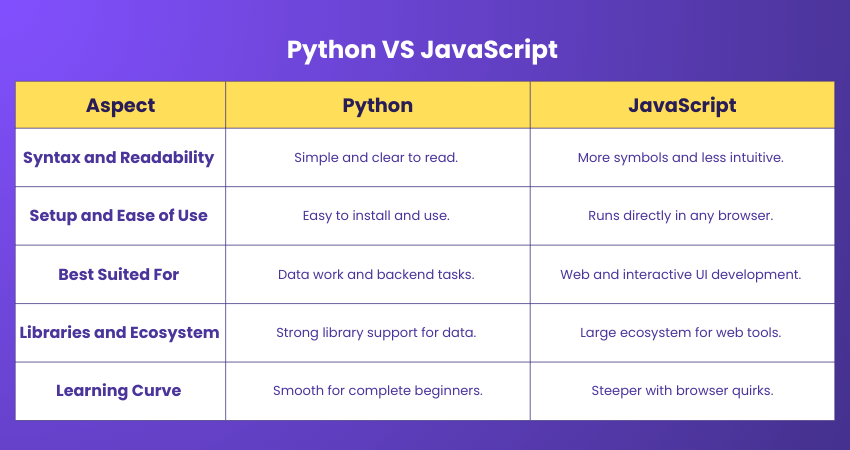
How Does Python Compare to JavaScript for Beginners?
The two most favored languages for new developers are Python and JavaScript, with each having its own merits. Python is mainly a language for beginners, as it has a syntax that is very close to English and is very readable.
Python is the language of choice for those who deal with data analysis, scripting, automation, or backend development. On the other hand, if a person wants to learn front-end development and interactive web apps, then JavaScript would be the best option since it allows the learner to see the output visually and hence understand better.
Conclusion
Grasping the Characteristics of Python reveals the reasons for its popularity and reliability as a programming language. Its easy-to-use nature, diverse usage scenarios, and solid ecosystem are the strong points of various project types. With developers' support in the form of tools and community, Python still is the number one option for contemporary development.
Empower yourself with programming skills with our Programming Training, Sign up now!
Frequently Asked Questions
How Does Learning Python Benefit a Career in Data Science?

Learning Python enhances a Data Science career by providing essential skills for data manipulation, analysis, and visualisation. Python's rich libraries, such as Pandas and NumPy, streamline data tasks, while its simplicity aids in quick problem-solving and effective communication.
How Does Python Handle Errors and Debugging?
Python uses tracebacks, built-in debugging tools (like print(), breakpoints and the pdb debugger) and exception handling to help developers identify, inspect and fix errors quickly and effectively.

The Knowledge Academy


Global Training Provider
The Knowledge Academy is a world-leading provider of professional training courses, offering globally recognised qualifications across a wide range of subjects. With expert trainers, up-to-date course material, and flexible learning options, we aim to empower professionals and organisations to achieve their goals through continuous learning.


 If you wish to make any changes to your course, please


