


 Top Rated Course

We may not have the course you’re looking for. If you enquire or give us a call on +44 1344 203 999 and speak to our training experts, we may still be able to help with your training requirements.
Failure Mode and Effects Analysis (FMEA): A Complete Guide
The Knowledge Academy 03 February 2026FMEA is a proactive method to identify potential failures, analyse their impact, and implement actions to enhance safety, reliability, and performance. It helps organisations prioritise issues, prevent costly errors, and improve overall efficiency. By addressing risks early, FMEA supports better quality control and customer satisfaction.

Training Outcomes Within Your Budget!
We ensure quality, budget-alignment, and timely delivery by our expert instructors.
Table of Contents
What if you could spot problems before they happen? Imagine knowing your car’s engine might fail before it actually does or predicting system breakdowns long before they cause chaos. Sounds efficient, doesn’t it? That’s exactly what Failure Mode and Effects Analysis (FMEA) gives businesses the power to prevent failures and keep everything running smoothly.
In this blog, we’ll uncover what Failure Mode and Effects Analysis is and why it’s so valuable. We’ll discuss its objectives, types, and real-world examples, explain the seven steps to perform it, explore tools and software, and dive into its benefits and limitations. So, let’s dive in
Table of Contents
1) What is Failure Mode and Effects Analysis (FMEA)?
2) Objective of FMEA
3) Types of FMEAs
4) How FMEA Works in Real Situations?
5) How to Perform FMEA: Seven Steps?
6) FMEA Example
7) FMEA Tools and Software Solutions
8) Benefits of Implementing Failure Analysis
9) What are the limitations of Failure Mode and Effects Analysis (FMEA)?
10) Conclusion
What is Failure Mode and Effects Analysis (FMEA)?
Failure Mode and Effects Analysis (FMEA) is a structured Risk Analysis method used to find potential failures in a product, process, or system before they happen. It uses data from past projects, customer feedback, and real-time performance to identify failure modes and understand their impact. FMEA also involves key stakeholders from different departments to make sure risks are properly assessed and managed.
FMEA helps to identify, prioritise, and mitigate these potential issues. It's not a replacement for solid engineering practices but rather a way to enhance them. By bringing together a Cross Functional Team (CFT), FMEA leverages their collective knowledge and experience to assess and manage the risks of failure throughout the design process.

Objective of FMEA
One of the main goals of FMEA is to help stakeholders make better decisions using accurate data for Risk Analysis, ensuring a clear view of risks and effective actions.
1 Prevent problems before they happen
2 Make products and processes better
3 Save money by avoiding extra work or repairs
4 Follow safety and industry rules
5 Keep improving things over time
Unleash your product potential! our Product Management Training will equip you with the skills to drive innovation. Start your journey today.
Types of FMEAs
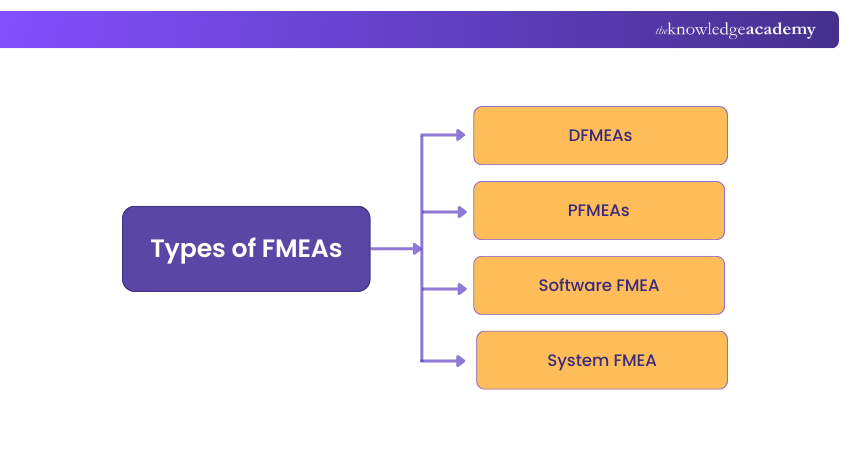
There are different types of FMEAs based on where and how they are used:
1) DFMEAs
Design FMEA is used to find problems in a product’s design before it is made. It helps prevent issues like the product not working properly, having a shorter life, or causing safety risks. It is used from the early design plans until the product is ready for production.
2) PFMEAs
Process FMEAs (PFMEAs) are used to find possible problems in the manufacturing or service process. They help prevent issues like defects in products, delays in production, or safety risks for workers. PFMEAs are done before and during the process to make sure everything runs smoothly, safely, and with good quality.
3) Software FMEA
Software FMEAs focus on identifying how software can fail and the impact of those breakdowns on the overall system. Given the increasing complexity and integration of software in modern systems, conducting Software FMEAs is crucial. They help address all potential failure paths and ensure the software is robust and reliable. This proactive approach is important for maintaining system integrity and performance.
4) System FMEA
System FMEA is used to find possible problems in the whole system before they happen. It uses relevant data to see how different parts work together and checks if one part’s failure can affect the others. This helps make the entire system safer, stronger, and more reliable.
How FMEA Works in RealSituations?
Once each failure mode is identified, we analyse the data and quantify three key factors:
1) Severity (SEV): This measures how severe the effect of the failure is from the customer's perspective. We ask, "How significant is the impact on the customer?"
2) Occurrence (OCC): This looks at how often each failure or its potential cause happens. We ask, "How likely is this failure mode to occur?"
3) Detection (DET): This assesses the likelihood of detecting the failure before it affects the customer. We ask, "How likely is it that our current system will catch this failure mode if it happens?"
Each factor is scored on a scale from 1 (best) to 10 (worst). The combined impact of these factors gives us the Risk Priority Number (RPN), calculated as:
RPN = SEV x OCC x DET
The RPN helps us prioritise which issues need more Quality Planning and attention.
Learn about tasks and rules for reliability assurance of complex equipment and systems. Join our Reliability Engineering Training now!
How to Perform FMEA: Seven Steps?
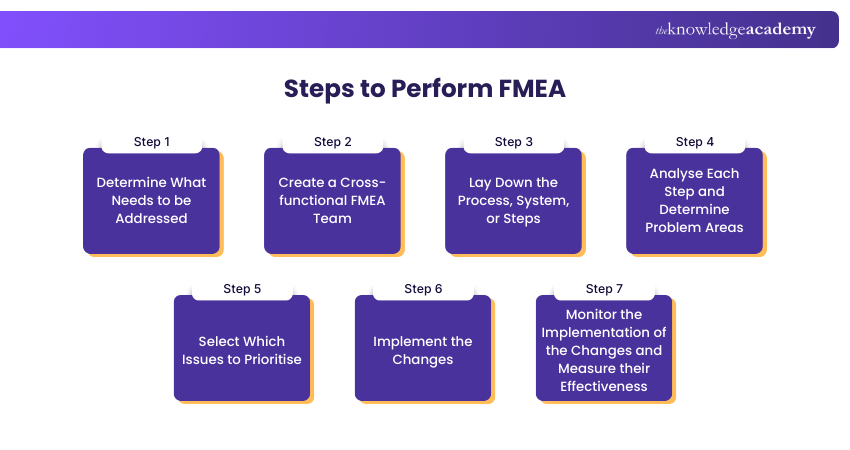
Failure Mode and Effects Analysis is usually done through a brainstorming session with a team of experienced members from different departments who know the process well. After finding possible problems, the team reviews risks again once solutions are applied to reduce or remove failures. Having a facilitator makes the process easier.
Step 1: Determine What Needs to be Addressed
First, identify which process, system, or part of the business has problems or could cause issues in the future. Think about whether there’s a new process that needs review, current processes creating problems, or signs like falling customer satisfaction or dropping sales. Choosing the right area to focus on helps you find and fix issues early.
Step 2: Create a Cross-functional FMEA Team
Build a team of people from different departments who understand the process, product, or system well. A team leader or coordinator guides the group, and everyone works together to find problems and suggest solutions.
Step 3: Lay Down the Process, System, or Steps
Make a team of people from different departments who know the process, Product Development, or system. A leader guides the team, and everyone works together to find problems and think of solutions. This helps to fix issues more effectively.
Step 4: Analyse Each Step and Determine Problem Areas
Create a team with people from different departments who understand the work well. A leader manages the team, and everyone works together to spot problems and find simple solutions. This makes it easier to solve issues quickly.
Step 5: Select Which Issues to Prioritise
Look at all the problems you found and choose the most important ones to fix first. Focus on the issues that cause the biggest risks, delays, or safety problems so they can be solved quickly. Fixing the most serious problems first helps improve quality and reduce future issues.
Step 6: Implement the Changes
After choosing which problems to fix, start making the changes. Use the solutions to reduce risks and make the process or Product Development better. Make sure everyone involved follows the new changes correctly.
Step 7: Monitor the Implementation of the Changes and Measure their Effectiveness
After making changes, check if they are working well. Watch the process, measure the results, and see if the problems are solved. If needed, make more changes to improve things further. This helps to keep the process smooth and effective.
FMEA Example
Here is a simple example to understand how Failure Mode and Effects Analysis works. It shows how the Risk Priority Number (RPN), calculated using relevant data and customer satisfaction data, helps decide which problem to fix first.
Failure Modes:
1) The machine does not start
2) The machine stops working in the middle of Product Development and it can be unsafe
3) The machine makes wrong products because of an unknown problem
RPN Calculation:
1) Severity (4) × Occurrence (3) × Detection (1) = RPN 12
2) Severity (6) × Occurrence (5) × Detection (1) = RPN 30
3) Severity (9) × Occurrence (4) × Detection (5) = RPN 180
The third problem has the highest RPN (180), so it is the most serious. You need to fix it first by reducing its impact, stopping it from happening, and making it easier to detect early.
Understand sustainability practices for greener facilities. Join our Facilities Management Training now!
FMEA Tools and Software Solutions
FMEA is a proactive strategy that identifies potential failure modes before they occur, helping to catch problems early and prevent later consequences. It's highly effective for management and monitoring.
With technological advancements, several excellent tools and software have emerged to automate and enhance the FMEA process:
1) ReliaSoft XFMEA: Used by major companies like Rolls-Royce and Coca-Cola, this robust software supports Process FMEA, System FMEA, Design FMEA, and FMEA.
2) Intelex FMEA: This software promotes collaboration and team-based problem-solving, helping organisations tackle complex issues collectively and manage workflows efficiently.
3) DataLyser FMEA: Part of the DataLyser Software suite, this module can be used independently and allows customisation of FMEA criteria to align with industry standards and trends.
4) Relyence FMEA: This tool automates the entire FMEA process, enabling seamless analysis for Design FMEAs, Process FMEAs, and custom FMEAs.
Benefits of Implementing Failure Analysis
Failure Mode and Effects Analysis (FMEA) implementation offers various organisational benefits across a wide range of industries:

1) Improved Processes and Product Quality: FMEA is a systematic and proactive approach to failure identification and failure reduction, which contributes to processes in a better manner, higher product quality, and overall business resilience.
2) Risk Management: As a Risk Management tool, FMEA helps in the systematic analysis of failure nodes in an organisation and their outcomes. This allows them to seamlessly perform risk identification. Moreover, this measure of implementation reduces the likelihood of failure impacts, thereby minimising business risk.
3) Cost-effectiveness: Potential failure addressed during the operational phase of development is more cost-effective than dealing with later issues. FMEA helps in risk identification and mitigation for organisations at an early stage, reducing the need for expensive corrective actions and financial loss prevention.
4) Enhanced Safety: In industries where safety is paramount, such as manufacturing and healthcare, FMEA plays a vital role in identifying failures that could compromise safety. Proactively addressing these failures helps create safer environments for both employees and end-users.
5) Operational Efficiency: FMEA provides insights into the weaknesses and inefficiencies of the processes. Organisations can use results from FMEA for their process optimisation and Overall Operational Efficiency (OEE) improvement.
What are the limitations of Failure Mode and Effects Analysis (FMEA)?
FMEA is very helpful, but it also has some limitations:
1) Takes Time: Doing FMEA can be slow, especially for big systems.
2) Needs Experts: It works best when experienced people are part of the team.
3) Based on Opinions: Risk ratings depend on what the team thinks and may not always be correct.
4) May Miss new Problems: FMEA mostly finds known issues and can miss unexpected ones.
5) Can be Costly: It may need extra money, tools, or training.
6) Needs Regular Updates: If not updated, the results can become outdated and less useful.
Conclusion
Failure Mode and Effects Analysis (FMEA) is a powerful tool that helps businesses find problems early, reduce risks, and improve quality and safety. By following its structured steps, organisations can prevent failures, save costs, and deliver better Product Development and services. Whether in design or processes, FMEA ensures systems work smoothly and reliably, making it essential for continuous improvement and success.
Learn to optimise logistics, procurement, inventory, and distribution processes. Join our Supply Chain Management Training now!
Frequently Asked Questions
What is the Difference Between Design FMEA (DFMEA) and Process FMEA (PFMEA)?

Design FMEA (DFMEA) finds and fixes design problems before Product Development, helping avoid malfunctions, shorter lifespan, and safety risks. Process FMEA (PFMEA) focuses on the manufacturing or service process to spot defects, delays, or safety hazards. DFMEA improves the design, while PFMEA improves the process.
What is Considered a High RPN Value in FMEA?
In FMEA, a "high RPN" varies by organisation and project. Since RPN ranges from 1 to 1000, any value may need action, especially if the severity is 9 or 10. Many set thresholds like 100 or 150 for urgent risks, while others focus on the top 20% of RPNs or use a Pareto approach to target critical issues.
What are the Other Resources and Offers Provided by The Knowledge Academy?
The Knowledge Academy takes global learning to new heights, offering over 3,000+ online courses across 490+ locations in 190+ countries. This expansive reach ensures accessibility and convenience for learners worldwide.
Alongside our diverse Online Course Catalogue, encompassing 19 major categories, we go the extra mile by providing a plethora of free educational Online Resources like Blogs, eBooks, Interview Questions and Videos. Tailoring learning experiences further, professionals can unlock greater value through a wide range of special discounts, seasonal deals, and Exclusive Offers.
What is The Knowledge Pass, and How Does it Work?
The Knowledge Academy’s Knowledge Pass, a prepaid voucher, adds another layer of flexibility, allowing course bookings over a 12-month period. Join us on a journey where education knows no bounds.
What are the Related Courses and Blogs Provided by The Knowledge Academy?
The Knowledge Academy offers various Industry Training, including Product Management Training, Reliability Engineering Training, and Supply Chain Management Training. These courses cater to different skill levels, providing comprehensive insights into Methods of Demand Forecasting.
Our Business Skills Blogs cover a range of topics related to Failure Mode and Effects Analysis, offering valuable resources, best practices, and industry insights. Whether you are a beginner or looking to advance your Business skills, The Knowledge Academy's diverse courses and informative blogs have got you covered.

The Knowledge Academy


Global Training Provider
The Knowledge Academy is a world-leading provider of professional training courses, offering globally recognised qualifications across a wide range of subjects. With expert trainers, up-to-date course material, and flexible learning options, we aim to empower professionals and organisations to achieve their goals through continuous learning.

Upcoming Business Skills Resources Batches & Dates
Date
 Product Management Training
Product Management Training
Fri 17th Jul 2026
Product Management Training
Fri 9th Oct 2026

 If you wish to make any changes to your course, please


