


 Top Rated Course

We may not have the course you’re looking for. If you enquire or give us a call on +971 8000311193 and speak to our training experts, we may still be able to help with your training requirements.
What Is Content Marketing? A Complete Guide for Beginners
Pearl Williams 17 April 2026Content Marketing shares valuable content to attract and engage audiences, build trust, and inspire meaningful actions that drive business growth. It answers real questions, solves real problems, and builds lasting relationships that turn attention into long-term brand loyalty and advocacy. This keeps audiences engaged.

Training Outcomes Within Your Budget!
We ensure quality, budget-alignment, and timely delivery by our expert instructors.
Table of Contents

People today want value, not sales pitches. They want to feel understood, informed, and inspired. That is where Content Marketing stands out. When people ask, What Is Content Marketing, the answer lies in how it turns useful ideas into meaningful connections, helping brands speak with people, not at them.
In a world crowded with ads, Content Marketing cuts through noise with clarity and purpose. It answers questions, shares insight, and builds trust. Every blog, video, or newsletter becomes a bridge between brands and real human needs. Let’s dive into this blog to explore What Content Marketing is and how it drives meaningful growth.
Table of Contents
1) What is Content Marketing?
2) Why is Content Marketing Important?
3) How Content Marketing Works?
4) Types of Content Marketing
5) Benefits of Content Marketing
6) How to create a content marketing strategy?
7) SEO and Content Marketing Working Together
8) Common Mistakes to Avoid in Content Marketing
9) Future Trends in Content Marketing
10) What is Content Marketing Personalisation?
11) What is Data-driven Content Marketing?
12) Conclusion
What is Content Marketing?
Content Marketing meaning, the ability to communicate with customers, prospects, and target audiences without directly selling to them. It is a strategic method focused on making and sharing valuable, high-quality, and relevant content to attract and retain a specific audience.
Unlike regular ads pushing products or services, Content Performance Marketing focuses on providing the audience with valuable insights, helpful solutions, and meaningful experiences. The main purpose is to attract top-of-the-funnel customers and build a strong bond with the audience. Thus, it helps lead to higher brand awareness, loyalty, and, ultimately, more sales.

Why is Content Marketing Important?
Content marketing is important because it helps businesses connect with their audience in a meaningful way. Instead of pushing direct sales messages, it provides value through useful, relevant information that builds trust and credibility.
It supports every stage of the buyer journey, from creating awareness to guiding decisions. Good content attracts the right audience, strengthens leads, improves brand visibility, and positions a business as an authority, making customers more likely to choose it when they are ready to buy.
How Content Marketing Works?
Businesses use Content Marketing to attract leads, which supports every stage of the buying process. Here’s how companies use Content Marketing in each stage to get the optimum benefits of the same:
1) Awareness Stage: This is the first stage, where customers realise they have a need. At this stage, content should focus on the pain points and challenges they face. The content in the awareness stage should be informative and help them understand that a solution exists for their problem. The best content for this stage is blogs, articles, and newsletters.
2) Consideration Stage: Consideration stage comes next as customer start looking for solutions to their problems. This stage should educate customers about the available options, and which suits their needs. Content should make them to consider your business. The best content for this stage includes how-to-videos, webinars, and explainer videos.
3) Closing Stage: This is the final stage, where customers are ready to make a decision. Content Marketing plays crucial role in this stage. Content in this stage should build trust and confidence. The best content for this stage includes testimonials, demos, free trials, and success stories.
The traditional marketing focuses mostly on the final two stages which are consideration and purchase. Content Marketing targets people in earlier stage that is during the awareness stage.
By sharing helpful, interesting, or educational content, companies build trust and attract potential customers before they’re even ready to buy.
Another big benefit of this is Search Engine Optimisation (SEO). When a company creates useful content related to what people are searching for, it helps the business show up on Google. Over time, this builds authority and brings in traffic without paid ads.
Types of Content Marketing
Content Marketing can be performed in various forms, which makes it a powerful marketing strategy. Here are popular Types of Content Marketing:

1) Blogs post
Blog posts and articles are the go-to content formats for many because they're easier and less risky. Writing high-quality blog posts not only improves your authority through SEO but also builds a strong connection with readers.
When your audience views your blog as a trusted source, they are more likely to believe in your recommendations, which, in turn, builds trust in your brand and products. In the long run, implementing effective website monetisation strategies can transform this trust into revenue, enabling you to further grow and sustain your online presence.
2) Infographics
Infographics are the second most powerful type to boost your Content Marketing game. Infographics help deliver information using eye-catching graphics, like graphs or flow charts.
When you present your data in the form of infographics, it looks more readable to your audience. Infographics Content Marketing is mostly ideal for small businesses as it is a low-cost marketing technique yet visually appealing. This provides a higher engagement rate.
3) Videos
Video marketing is also regarded as one of the best investments in Content Marketing strategy as it results in higher traffic, engagement, and sales. Creating engaging video content, such as tutorials and webinars, can attract and inform a wider audience. Video marketing includes a wide range of formats like the following:
a) Tutorials
b) Product demonstrations
c) Interviews
d) Webinars
e) Vlogs
f) Short-form content for platforms like TikTok or Instagram Reels
4) Email
Email marketing has become widespread as it drives a huge ROI. Nowadays, almost three in four businesses utilise email newsletters to promote their Content. Email Marketing has diverse applications. They can use emails to reveal product launches and use them for newsletters that include subscriptions, discounts and promo codes, and informational Content.
5) Podcast
According to Nuvoodoo, more than 50% of people listen to podcasts while driving. That means people are increasingly moving towards listening to podcasts. So, with Podcast marketing, you can push Content Marketing to the next level.
Many businesses underestimate the power of podcasting because they have no idea how to use audio-only Content. But little do they know that podcasts are a growing platform for businesses to reach their target audience.
6) Social Media
Social media platforms, including Instagram, Facebook, and Twitter, have emerged as the strongest Content Marketing platform. It’s effortless to use and can generate leads without much investment. By adding your product or website link on social media platforms, you can create leads and direct sales.
Today, every small to big business is building a social presence as a form of marketing. You can use videos, carousels, short content, and stories to educate your audience about your products or services. Apart from this, you can also run social media campaigns using paid promotions or ads since it has a higher audience.
7) E-books
E-books are effective B2B Content Marketing types that help in building credibility. It works differently compared to blog posts. They are usually long-form and provide in-depth knowledge about a particular topic. The e-book helps generate leads, although you must ensure that these digital publications deliver high-quality and genuine value.
Unlock your career potential with our Introduction to Marketing Training to gain a competitive edge. Join now!
Benefits of Content Marketing
The following are some of the Benefits of Content Marketing. Let's explore each of them in detail:
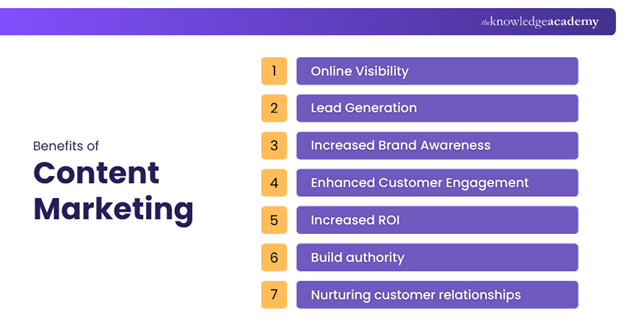
1) Online Visibility
Content Marketing connects your business with more customers and website visitors, particularly when people are looking for something specific. Search engines reward websites that develop high-quality, relevant content with better search rankings.
Through effective content optimisation and the use of relevant keywords, businesses can attract organic traffic to their websites. This results in increased visibility and potential leads.
Create ideas that matter and be the innovator your community needs – Start your Social Innovation Course now!
2) Lead Generation
Content Marketing is also used to create leads and prospects. How? By driving traffic. This strategy helps in driving organic traffic to the website. When customers build their trust through your informative content and start feeling comfortable buying from your business. Thus, you can generate more leads and strengthen your relationship with potential customers.
3) Increased Brand Awareness
Brand awareness is another key reason why Content Marketing is important. It’s all about bringing your audience to get involved in what you do. When a person comes across your Content on Search Engine Result Pages (SERPs) or a post on social media platforms, they are exposed to your brand. As a result, they develop a connection with your products and services.
4) Enhanced Customer Engagement
Content Marketing can greatly support your business as it brings your brand name closer to the target market. It encourages meaningful interactions with the audience through likes, shares, comments, and discussions. This engagement not only strengthens the brand-consumer relationship but also widens the Content's reach through social sharing.
5) Increased ROI
The main aim of Content Marketing is to get more out of what you put in. When done properly, it can generate a high Return on Investment (ROI). After all, it's every company’s objective; to generate greater profits by increasing customer engagement.
6) Build Authority
Creating informative content allows them to showcase their expertise and knowledge. This positioning as a knowledgeable resource not only builds credibility but also develops a sense of trust among customers. When customers see a brand as credible, they're more likely to buy things from them.
7) Nurturing Customer Relationships
Content Marketing offers businesses to connect with their audience on a personal level. By addressing the problems, needs, and desires of their customers, brands can establish an emotional connection that is not just about buying and selling. This connection makes customers want to stick around, buy again, and tell others about it.
How to Create Content Marketing Strategy?
After understanding What Content Marketing is and its types, it's time to explore ways to create impactful strategies. In today's digital landscape, writing a blog/article or uploading a video has become easier than ever. However, to achieve marketing goals, building a clear content marketing funnel is essential to support a well-defined plan. This is where the Content Marketing Strategy Guide comes into play. How does it work? Let’s dive into the key steps to implement an effective Content Marketing Strategy.
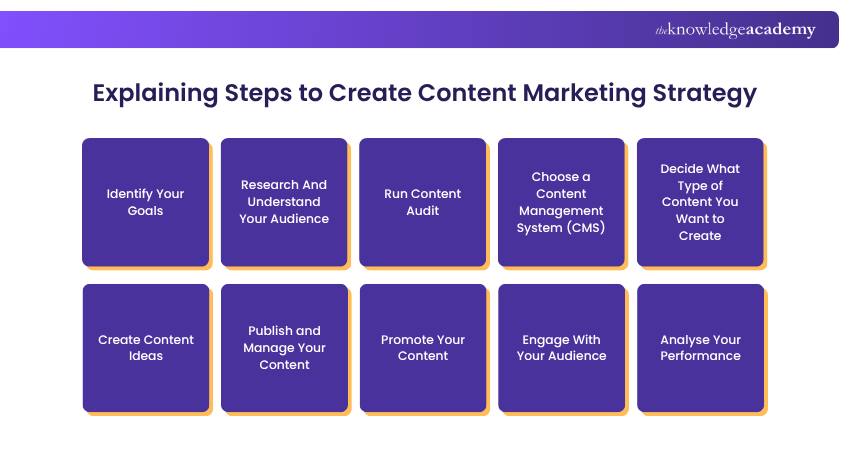
1) Identify Your Goal
Setting a clear goal is the core step of an effective Content Marketing Strategy. Research the business and domain market and look at high-level business goals.
Moreover, figure out what you want to achieve – whether it's increasing website traffic, growing your email list, boosting sales, or enhancing brand awareness. Defining your goals guides your Content strategy and ensures that every piece of Content aligns with your overall business goals.
2) Research and Understand Your Audience
Understanding your audience is the most crucial part of the content strategy. By knowing your audience, you can develop relevant Content that the audience finds interesting and informative.
This information helps you develop content that resonates with them, solves their problems, and builds a stronger connection. This ultimately leads to higher engagement and conversions.
3) Run Content Audit
Run a content audit to analyse your lowest-performing and top-performing Content. Also, conduct a comprehensive review of your existing content. Analyse its performance, including views, shares, comments, and conversions. This highlights your strengths, identifies gaps, and provides insights into topics and formats that resonate most with your audience.
4) Choose a Content Management System (CMS)
Content creation, content publications, and content analytics are the crucial components of the Content Management System (CMS). A good CMS streamlines Content creation, editing, and distribution while enhancing your overall Content Marketing process. Choose a reliable Content Management System to organise, publish, and manage your Content effectively.
Advance strategic insight with our Marketing Research Training – Join Today!
5) Decide What Type of Content You Want to Create
Identify content formats that best suit your goals and resonate well with your target audience. Your content should provide genuine value to them. So, consider options such as blog posts, videos, podcasts, infographics, books, webinars, and social posts. Make sure the chosen formats align with your audience's preferences and your available resources.
6) Create Content Ideas
Brainstorm a list of content ideas based on your audience's needs and interests. Start by exploring industry trends, Frequently Asked Questions (FAQs), and problems that your products or services can address.
Moreover, add your ideas to the Content calendar. These ideas are the foundation for your Content creation strategy. So, make sure to jot down creative and relevant Content ideas.
7) Publish and Manage Your Content
Once you have created a list of ideas, it's time to produce and share content according to your content calendar. Come up with captivating headlines and make sure your content delivers value, educates, entertains, and informs your target audience. Also, utilise SEO best practices to optimise your content for search engines while improving its accountability.
8) Promote Your Content
Share your content across multiple platforms like Facebook, Instagram, and YouTube to maximise its reach. Leverage social media platforms, email newsletters, influencer collaborations, and online communities to amplify your Content's visibility. Also, try to personalise your promotional efforts to each platform's unique audience and features, as it will help with higher engagement and reach.
9) Engage with Your Audience
Your effort doesn’t stop here. Once your content is published, you should actively engage with the audience to build your relationships. Encourage interactions and discussions around your Content. Further, respond to their comments, messages, and inquiries instantly. This helps cultivate loyalty and encourages them to become brand advocates.
10) Analyse Your Performance
Make use of tools like Google Analytics, social media insights, and email marketing analytics to track the performance of your content. Monitor metrics, including website traffic, engagement rates, social media shares, and conversion rates. This information will help you understand what is working and what needs improvement.
Leve-up your marketing game with our Email Marketing Course, Join today!
SEO and Content Marketing Working Together
SEO and Content Marketing are known as close partners. They work hand in hand to help businesses improve visibility, attract more visitors, and drive engagement. Here are the key points:
1) Content Gives SEO Purpose
At its core, SEO is about helping your website be visible in search engine results. But search engines like Google need something to rank and that’s where content comes in.
Blogs, articles, videos, infographics, and landing pages provide the information that search engines crawl and index. Without content, there’s nothing for SEO to optimise.
2) Keywords Connect Content to Search
Content Marketing allows you to naturally include keywords, terms your target audience is searching for within your content. When done well, this improves your chances of appearing on the first page of search results.
SEO research helps identify what those keywords should be. The content brings them to life in a helpful and readable way.
3) Quality Content Builds Authority
Search engines reward websites that publish trustworthy, valuable, and original content. Content Marketing focuses on solving user problems, answering common questions, and providing insights.
All these helps build domain authority. Over time, this makes your site more likely to rank for competitive keywords.
4) Backlinks and Shareability
Great content naturally earns backlinks from other websites and gets shared across platforms. Both are important ranking factors for SEO.
Content like guides, original research, and thought leadership pieces often attract links that boost your website’s credibility in the eyes of search engines.
5) User Experience and Engagement
SEO isn’t just about rankings; it’s also about keeping people on your site. Engaging, well-structured content improves user experience, reduces bounce rates, and encourages longer time spent on the page. These are all positive signals for search engines.
6) Consistent Content Supports Long-term SEO
Regularly publishing new, optimised content keeps your site active and signals to search engines that your website is current and relevant.
Over time, this can improve your site's rankings and bring in a steady flow of organic traffic.
Common Mistakes to Avoid in Content Marketing
Here are some common mistakes that Content marketers need to avoid creating a brand value in the market. Here are some of them:
1) Lack of a Clear Strategy: Creating content without a defined goal, audience, or plan can lead to wasted effort.
2) Ignoring Your Target Audience: Trying to appeal to everyone weakens your message.
3) Publishing Low-Quality or Thin Content: Content that lacks depth, value, or originality won’t rank well and may hurt your credibility.
4) Overlooking SEO Basics: Neglecting keyword research, metadata, and on-page SEO can stop great content from being found.
5) Being Too Promotional: Content should educate, inform, or entertain, not just sell. Too much self-promotion drives users away.
6) Inconsistent Posting Schedule: Irregular publishing can cause you to lose audience interest.
7) Ignoring Analytics and Feedback: Failing to measure content performance means missed opportunities for improvement.
8) Not Updating Old Content: Letting old content become outdated affects SEO and credibility.
9) Skipping Call-to-actions (CTAs): Every piece of content should guide users toward a next step. It can be reading another article, signing up, or making a purchase.
10) Neglecting Visual Elements: Walls of text can overwhelm readers as some of them neglect visualisation.
Future Trends in Content Marketing
Content Marketing offers wide range of Future career opportunities. Let's discuss about some of them:
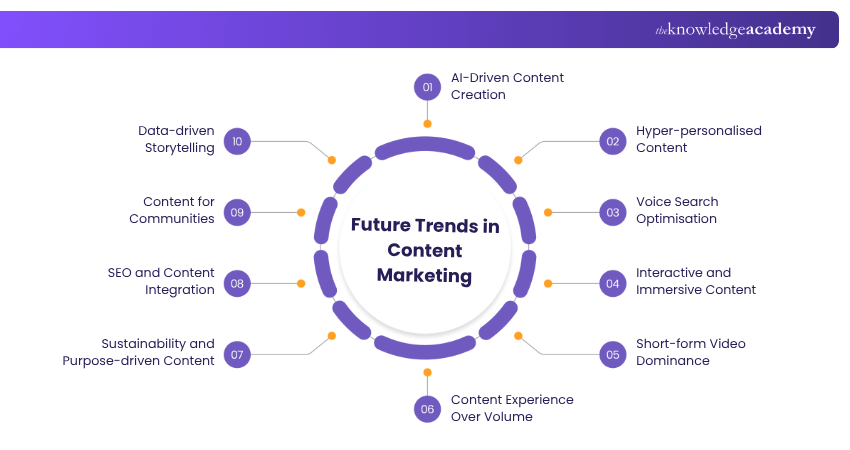
1) AI-Driven Content Creation
Artificial Intelligence tools like ChatGPT are being used to generate drafts, optimise content, and personalise messaging at scale. AI can save time, analyse performance, and suggest improvements based on data.
2) Hyper-personalised Content
Audiences now expect tailored experiences. Future content will be more personalised based on user behaviour, location, interests, and past interactions, delivered at the right moment on the right platform.
3) Voice Search Optimisation
With the rise of smart speakers and voice assistants, content must be optimised for natural language queries and featured snippets to capture voice-based traffic.
4) Interactive and Immersive Content
Quizzes, polls, interactive infographics, AR/VR experiences, and shoppable videos will become more common to increase engagement and user interaction.
5) Sustainability and Purpose-driven Content
Consumers are becoming more values driven. Brands that showcase their commitment to sustainability, ethics, and social impact through authentic content will build stronger loyalty.
6) SEO and Content Integration
The future of Content Marketing lies in its deep integration with SEO. It is especially with Google’s evolving algorithms focusing on user intent, E-E-A-T (Experience, Expertise, Authoritativeness, and Trust).
What is Content Marketing Personalisation?
Content marketing personalisation is the practice of tailoring your content to match the interests, behaviours, and needs of specific people, instead of showing the same content to everyone. It uses data such as past interactions, preferences, and demographics to deliver relevant messages that feel more personal.
When content is personalised, it increases engagement, builds stronger connections, and improves the chances that people will take action, like signing up, downloading something, or buying a product.
What is Data-driven Content Marketing?
Data-driven Content Marketing is the use of insights from data like audience behaviour, search trends, and engagement metrics. This are to plan, create, and optimise content.
It helps marketers make informed decisions, target the right audience, personalise messaging, and measure performance to improve results and maximise ROI.
Conclusion
This blog answers What Is Content Marketing and shows why it matters for the future. It is about delivering real value that builds trust, sparks engagement, and guides your audience through every stage of their journey. With relevance, consistency, and clear strategy, content helps brands reach the right people at the right time.
Whether your goal is to boost visibility, generate leads, or strengthen customer relationships, understanding Content Marketing reveals a cost-effective path to growth. As digital habits evolve, brands that invest in purposeful, high-quality content will continue to stand out and grow.
Learn the art of marketing with our rigorous Content Marketing Course and become an expert Content Marketer. Join today!
Frequently Asked Questions
How Does Social Media Support Content Marketing?

Social media supports Content Marketing by amplifying reach, driving traffic, and boosting engagement. It helps share content directly with target audiences, encourages real-time interaction, and provides feedback.
Platforms like LinkedIn, Instagram, and X also help build brand awareness and foster loyal communities around valuable content.
How Cost-effective is Content Marketing?
Content Marketing is highly cost-effective compared to traditional advertising. It generates 3x more leads per dollar and builds long-term value through evergreen content.
Though it takes time to show results, consistent, quality content can drive organic traffic, boost brand trust, and deliver strong ROI over time with lower ongoing costs.
What are the Other Resources and Offers Provided by The Knowledge Academy?
The Knowledge Academy takes global learning to new heights, offering over 3,000+ online courses across 490+ locations in 190+ countries. This expansive reach ensures accessibility and convenience for learners worldwide.
Alongside our diverse Online Course Catalogue, encompassing 19 major categories, we go the extra mile by providing a plethora of free educational Online Resources like Blogs, eBooks, Interview Questions and Videos. Tailoring learning experiences further, professionals can unlock greater value through a wide range of special discounts, seasonal deals, and Exclusive Offers.
What is The Knowledge Pass, and How Does it Work?
The Knowledge Academy’s Knowledge Pass, a prepaid voucher, adds another layer of flexibility, allowing course bookings over a 12-month period. Join us on a journey where education knows no bounds.
What are the Related Courses and Blogs Provided by The Knowledge Academy?
The Knowledge Academy offers various Marketing Courses, including the Marketing Budget Course, Email Marketing Course and the Web Analytics Course. These courses cater to different skill levels, providing comprehensive insights into Brand Equity.
Our Digital Marketing Blogs cover a range of topics related to Content Marketing, offering valuable resources, best practices, and industry insights. Whether you are a beginner or looking to advance your Digital Marketing skills, The Knowledge Academy's diverse courses and informative blogs have got you covered.
Upcoming Digital Marketing Resources Batches & Dates
Date
 Content Marketing Course
Content Marketing Course
Fri 31st Jul 2026
Content Marketing Course
Fri 2nd Oct 2026

 If you wish to make any changes to your course, please


