


 Top Rated Course

We may not have the course you’re looking for. If you enquire or give us a call on +971 8000311193 and speak to our training experts, we may still be able to help with your training requirements.
What is Data Grid: An In-depth Introduction
The Knowledge Academy 21 April 2026A Data Grid refers to a distributed system that manages large datasets across computers, or a UI component used to display, sort, filter, and manage them. Instead of relying on a centralised database, it spreads data across servers, locations, or even cloud environments, ensuring faster access, better scalability, and high availability.

Training Outcomes Within Your Budget!
We ensure quality, budget-alignment, and timely delivery by our expert instructors.
Table of Contents

Managing large amounts of data is a daily challenge modern organisations encounter. This is where the importance of the Data Grid comes into play. It spreads data across multiple systems, enabling organisations to access information from their applications quickly and reliably, even during phases of heavy workloads.
It helps teams handle growth by improving performance, supporting scalability, and reducing the risk of system failure. In this blog, you will learn about what Data Grid is, how it works, key benefits, and more to help you manage data with simplicity and efficiency.
Table of Contents
1) What is Data Grid?
2) How Does Data Grid Work?
3) Benefits and Use Cases
4) Drawbacks of Data Grid
5) What are the Key Differences Between Data Grids and Data Lakes?
6) How is the Data Stored in a Data Grid?
7) Conclusion
What is Data Grid?
A Data Grid is a network of computers that work together to handle large tasks. These computers are often located in different places and connected across multiple sites. Each site may host one or more computers, and they all share data and resources to complete the work.
The primary purpose of a Data Grid is to harness the collective power of multiple computers to accomplish a task. This approach is called grid computing. Special software runs on each computer to manage tasks and control how users access data across the entire grid.
How Does Data Grid Work?
The core principle of a Data Grid is the allocation of data across various nodes and servers within a network. Here are the key points to remember about how a Data Grid works:
1) A Data Grid uses specialised software installed on each participating computer.
2) This software manages and coordinates all tasks across the grid.
3) Data is distributed across multiple nodes to improve availability and performance.
4) Applications can access data from the nearest or least busy node.
5) If one node fails, data remains accessible from the other node, and results are collected for the final output.
6) The software also enables network communication between computers to share task updates and coordinate results.
Visualise insights like a pro with our comprehensive Google Data Studio Training - Sign up now!
Benefits and Use Cases
Here are some benefits of Data Grids:
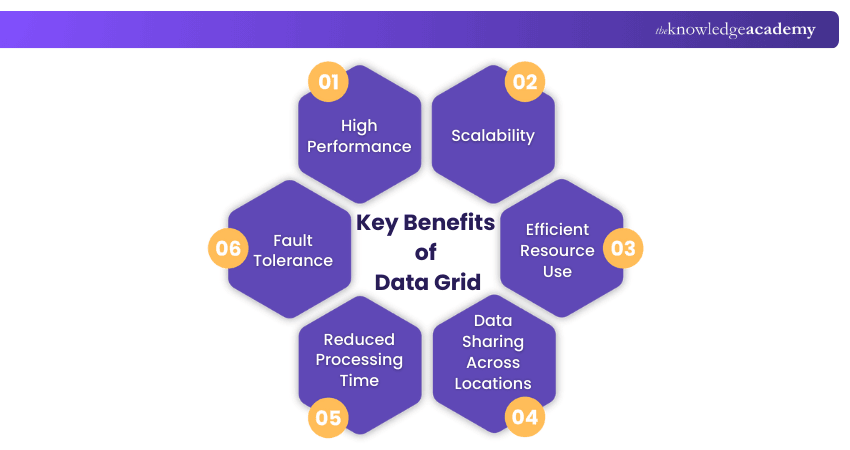
1) High Performance: A Data Grid boosts performance by combining the power of many computers to handle large tasks faster and more efficiently.
2) Scalability: It is easy to scale a Data Grid by adding more computers as the demand for processing or storage increases.
3) Fault Tolerance: If one computer in the grid fails, others can take over, ensuring the system continues to run without major disruptions.
4) Efficient Resource Use: Data Grids utilise underutilised computers across various locations, enabling organisations to derive more value from existing resources.
5) Data Sharing Across Locations: They enable teams in different locations to access and work with the same data, supporting better collaboration.
6) Reduced Processing Time: By dividing tasks and running them in parallel, Data Grids help complete large jobs much faster.
Now let’s take a look at some of the prominent use cases of Data Grid:
1) Scientific Research: Data grids are widely used in scientific fields like climate research, physics, and genetics to analyse huge sets of data.
2) Financial Services: Banks and financial firms use Data Grids to run complex models, risk assessments, and high-speed trading systems.
3) Healthcare: In healthcare, Data Grids support tasks such as drug development, processing medical images, and analysing patient data.
4) Engineering and Manufacturing: Companies use Data Grids for product design simulations, testing prototypes, and managing production data.
5) Media and Entertainment: Studios and broadcasters use Data Grids for video rendering, animation, and various live streaming tasks that require a lot of computing power.
6) Government and Defence: Governments use Data Grids for handling satellite imagery, security surveillance, and large-scale intelligence Data Analysis.
Create, edit, and collaborate on documents faster with Google Docs Training – Join now!
Drawbacks of Data Grid
While Data Grid delivers various benefits, it also comes with its own set of challenges that organisations must consider beforehand.
1) Management Complexity: Managing distributed nodes, data consistency, and system health increases due to operational complexity.
2) High Infrastructure Costs: In-memory storage and added computing resources can raise implementation and maintenance costs.
3) Network Performance Bottlenecks: Data replication and synchronisation may strain network bandwidth and cause latency issues.
What are the key Differences Between Data Grids and Data Lakes?
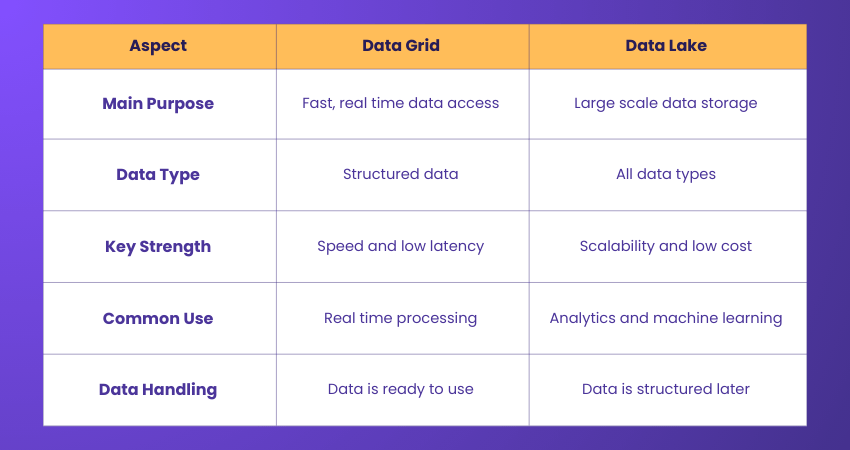
Data Grids and Data Lakes have different roles in managing data. A Data Grid is a system made up of multiple computers that work together to access and process structured data quickly. It’s ideal for real-time tasks, such as those in finance or scientific research, as it prioritises speed, in-memory computing, and rapid data access.
On the other hand, a Data Lake is a central place to store large amounts of raw data in any format; structured, semi-structured, or unstructured. It’s designed for scaling up easily and storing data at a lower cost. Data Lakes are useful for tasks like analytics, Machine Learning, and working with historical data. Unlike Data Grids, they let users define how to read the data later, offering more flexibility. While Data Grids focus on speed, Data Lakes focus on storage and analysis.
Dive into the world of computer logic and innovation! Sign up for our Computer Science Course now!
How is the Data Stored in Data Grid?
In a Data Grid, data is not stored in one server; instead, it is distributed across multiple nodes within the grid. This distributed storage model improves performance, scalability, and availability by using the combined storage and computer power of connected systems.
Data is stored using two key techniques: partitioning and replication. Partitioning divides large datasets into smaller parts and assigns them to different nodes for faster data handling. Replication creates multiple copies of data across nodes to ensure high availability and fault tolerance.
Conclusion
A Data Grid offers a powerful way to manage and access data. Distributing data across multiple nodes improves performance, scalability, and availability while reducing downtime. Understanding this process is beneficial for organisations in making smart decisions about their data structure. As data volumes continue to grow, adopting the right approach to data storage is key to building high-performance systems.
Strengthen everyday digital skills and work more efficiently with technology with End User Training – Register now!
Frequently Asked Questions
What are the Different Types of Data Grids?

Data Grids come in various types, primarily including manuscript, column, modular, and hierarchical Grids. Each serves a specific design purpose, from organising text to managing complex layouts with multiple elements.
What are Some Popular Data Grid Technologies?
Popular Data Grid technologies include AG Grid for high performance and real-time data handling. Also, framework-friendly tools, such as Sync fusion, Kendo UI, and Handson table, are preferable. There are also flexible options, such as TanStack Table and Tabulator, that support custom layouts, editing, and scalable web applications.
What are the Other Resources and Offers Provided by The Knowledge Academy?
The Knowledge Academy takes global learning to new heights, offering over 3,000 online courses across 490+ locations in 190+ countries. This expansive reach ensures accessibility and convenience for learners worldwide.
Alongside our diverse Online Course Catalogue, encompassing 19 major categories, we go the extra mile by providing a plethora of free educational Online Resources like Blogs, eBooks, Interview Questions and Videos. Tailoring learning experiences further, professionals can unlock greater value through a wide range of special discounts, seasonal deals, and Exclusive Offers.
What is the Knowledge Pass, and how Does it Work?
The Knowledge Academy’s Knowledge Pass, a prepaid voucher, adds another layer of flexibility, allowing course bookings over a 12-month period. Join us on a journey where education knows no bounds.
What are Related Courses and Blogs Provided by the Knowledge Academy?
The Knowledge Academy offers various End User Courses, including the Google Sheets Course, the Google Data Studio Training and the Google Docs Training. These courses cater to different skill levels, providing comprehensive insights into Creating Google Forms.
Our Office Applications Blogs cover a range of topics related to Data Grids, offering valuable resources, best practices, and industry insights. Whether you are a beginner or looking to advance your Data Management skills, The Knowledge Academy's diverse courses and informative blogs have got you covered.

The Knowledge Academy


Global Training Provider
The Knowledge Academy is a world-leading provider of professional training courses, offering globally recognised qualifications across a wide range of subjects. With expert trainers, up-to-date course material, and flexible learning options, we aim to empower professionals and organisations to achieve their goals through continuous learning.

Upcoming Office Applications Resources Batches & Dates
Date
 Introduction to Database Training
Introduction to Database Training
Fri 7th Aug 2026
Introduction to Database Training
Fri 6th Nov 2026

 If you wish to make any changes to your course, please


