


 Top Rated Course


We may not have the course you’re looking for. If you enquire or give us a call on +971 8000311193 and speak to our training experts, we may still be able to help with your training requirements.
CRUD Operations in MongoDB: A Complete Guide
The Knowledge Academy 07 March 2026Explore the world of MongoDB CRUD operations in this comprehensive resource. Gain insights into understanding the fundamentals of MongoDB CRUD operations and master the core CRUD operations, including creating, reading, updating, and deleting documents. Whether you're a beginner or an experienced developer, this blog has you covered.

Training Outcomes Within Your Budget!
We ensure quality, budget-alignment, and timely delivery by our expert instructors.
Table of Contents

MongoDB, a NoSQL database, has gained significant popularity due to its flexibility and scalability in managing vast amounts of unstructured data. One of the fundamental features that make MongoDB a favourite among developers is its support for Create, Read, Update, and Delete (CRUD) operations. CRUD Operations in MongoDB form the foundation for its database management system.
According to MongoDB, the database has been downloaded over 365 million times globally, showing its popularity in the community. Read this blog to learn about the essential CRUD Operations in MongoDB and understand how they can be effectively used to manipulate data in your applications.
Table of Contents
1) Understanding MongoDB CRUD operations
2) Performing CRUD Operations in MongoDB
a) Installing PyMongo
b) Connecting to MongoDB
c) Creating documents
d) Reading documents
e) Updating documents
f) Deleting documents
3) Best Practices for using CRUD operations
4) Conclusion
Understanding MongoDB CRUD Operations
CRUD operations are the cornerstone of any database management system. These operations in MongoDB allow you to perform various tasks, such as inserting new documents, querying data, updating existing documents, and removing data from collections. The four primary CRUD operations in MongoDB are:
a) Create (C): This operation involves adding new documents to a collection, similar to rows in a traditional relational database. MongoDB uses BSON (Binary JSON) to represent data, making it easy to work with complex data structures.
b) Read (R): The Read operation retrieves data from the database, allowing you to query specific documents or retrieve all documents in a collection. MongoDB provides powerful querying capabilities that enable you to search for data using various criteria.
c) Update (U): With the Update operation, you can modify existing documents in the database. MongoDB supports various update operators to tailor your modifications, ensuring efficient and precise updates.
d) Delete (D): The Delete operation removes documents based on specified criteria from a collection. Care should be taken while using the Delete operation, as it permanently removes data from the database.
Unlock the power of MongoDB and become a skilled developer with our comprehensive MongoDB Developer Course!
Performing CRUD Operations in MongoDB
You must use a programming language and its corresponding MongoDB driver to interact with MongoDB and perform CRUD operations. The following illustrates the Python programming language and the PyMongo driver.
Installing PyMongo
Before getting started, you need to install PyMongo. You can use pip, the Python package manager, with the following command:
|
pip install pymongo
|
Connecting to MongoDB
To initiate a connection to your MongoDB server, use the MongoClient class provided by PyMongo. The following code shows how to connect:
|
import pymongo # Replace 'mongodb://localhost:27017' with your MongoDB server URI client = pymongo.MongoClient('mongodb://localhost:27017') |
Creating documents
To create documents in a MongoDB collection, use the insert_one() or insert_many() methods. The insert_one() method adds a single document, while insert_many() adds multiple documents at once. Here's an example:
|
# Assuming 'my_db' is the name of your database and 'users' is the name of your collection db = client.my_db users = db.users # Insert a single document user_data = { 'name': 'John Doe', 'email': 'john.doe@example.com', 'age': 30 } result = users.insert_one(user_data) print(f"Inserted document id: {result.inserted_id}") |

Reading documents
To read data from a MongoDB collection, use the find() method. You can specify filters to retrieve specific You can specify documents or leave them empty to retrieve all documents. The following example demonstrates how to retrieve all documents using MongoDB Update Document, allowing you to fetch the required data efficiently.
|
# Retrieve all documents from the 'users' collection all_users = users.find() for user in all_users: print(user) |
Updating documents
Use the update_one() or update_many() methods to update existing documents. The update_one() method modifies a single document, while update_many() updates multiple documents. Here's an example:
|
# Update the age of the user with email 'john.doe@example.com' query = {'email': 'john.doe@example.com'} new_age = {'$set': {'age': 35}} result = users.update_one(query, new_age) print(f"Modified {result.modified_count} document") |
Deleting documents
To delete documents from a MongoDB collection, use the delete_one() or delete_many() methods. The delete_one() method removes a single document, while delete_many() deletes multiple documents. Example:
|
# Delete the user with name 'John Doe' query = {'name': 'John Doe'} result = users.delete_one(query) print(f"Deleted {result.deleted_count} document") |
Ready to speak the language of the web? Begin your coding journey with our Introduction to HTML course!
Best practices for using CRUD operations
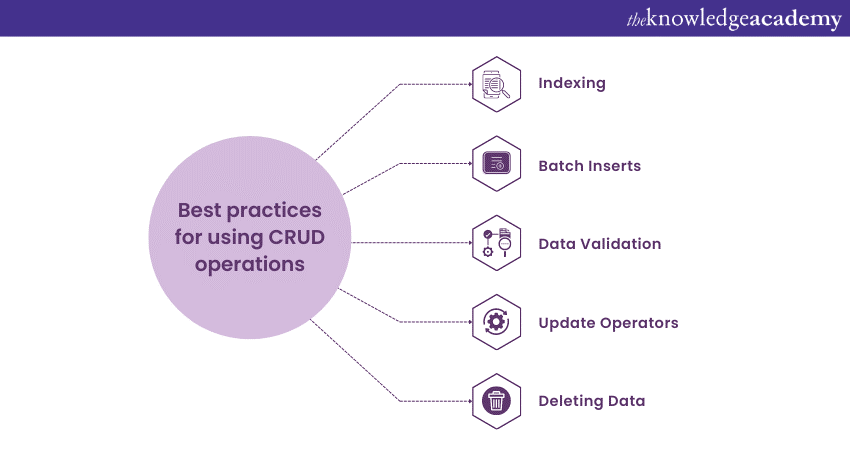
To optimise the performance and maintain data integrity, consider the following best practices while using CRUD Operations in MongoDB:
a) Indexing: Create appropriate indexes on fields commonly used for querying to speed up the read operation.
b) Batch Inserts: Use insert_many() for bulk inserts to minimise round-trips to the server.
c) Data Validation: Implement data validation to ensure that only valid data is inserted or updated.
d) Update Operators: Familiarise yourself with MongoDB's update operators to perform complex updates efficiently.
e) Deleting Data: Exercise caution while using the Delete operation, as it permanently removes data from the database.
Elevate the user experience! Dive into our UX/UI Design Jumpstart course and create intuitive, stunning interfaces!
Conclusion
We hope you enjoyed reading this blog and understood the CRUD Operations in MongoDB. Understanding these operations is crucial for building robust and efficient applications interacting with MongoDB. With MongoDB's power and flexibility, developers can create sophisticated data-driven applications that scale with ease. Remember to follow best practices to optimise performance and ensure data integrity. Happy coding!
Unlock endless possibilities in the digital world! Join our comprehensive App and Web Development Training!
Frequently Asked Questions

The Knowledge Academy


Global Training Provider
The Knowledge Academy is a world-leading provider of professional training courses, offering globally recognised qualifications across a wide range of subjects. With expert trainers, up-to-date course material, and flexible learning options, we aim to empower professionals and organisations to achieve their goals through continuous learning.


 If you wish to make any changes to your course, please


