


 Top Rated Course

We may not have the course you’re looking for. If you enquire or give us a call on +971 8000311193 and speak to our training experts, we may still be able to help with your training requirements.
CISSP Exam Requirements: Eligibility and Experience
The Knowledge Academy 23 February 2026CISSP Exam Requirements include at least five years of full-time, paid work experience in two or more of the eight domains of the CISSP Exam framework areas. This blog outlines all essential criteria for the CISSP Exam, including experience waivers, exam structure, domain areas, and prerequisites to help you prepare with confidence.

Training Outcomes Within Your Budget!
We ensure quality, budget-alignment, and timely delivery by our expert instructors.
Table of Contents
Thinking about appearing for the CISSP Exam but unsure whether you actually qualify? Many cybersecurity professionals delay their journey into CISSP simply because the eligibility rules seem complicated and intimidating at first glance.
The CISSP Exam validates your real-world security expertise, leadership capability, and professional credibility. However, you need to clearly understand its work experience requirements, the eight security domains, and available experience waivers. In this blog, we will explore CISSP Exam Requirements, so you can confidently evaluate your readiness and take the next step toward the CISSP journey. Let's dive in!
Table of Contents
1) What is CISSP?
2) Why Should You Take the CISSP Examination?
3) CISSP Experience Requirements
4) CISSP Common Body of Knowledge (CBK) - Eight Domains
5) Current Update for CISSP Exam
6) What are the Prerequisites for CISSP?
7) What is the Salary of a CISSP Qualified Person?
8) Conclusion
What is CISSP?
Certified Information Systems Security Professional (CISSP) is an internationally known certification provided by the International Information System Security Certification Consortium ISC2. It is designed for professionals who already have practical, hands-on experience in cybersecurity.
The CISSP shows a high level of proficiency and real-life experience in managing and protecting Information Technology (IT) systems. It is particularly suitable for individuals aiming for leadership, management, or senior-level roles in the Information Security field.

Why Should You Take the CISSP Examination?
CISSP is widely recognised as a top-level, globally recognised certification offered by the ISC2 to experienced cybersecurity professionals. It validates a candidate’s ability to design, implement, and manage an effective cybersecurity programme, making it a trusted credential across industries and sectors worldwide.
The CISSP certification is highly valued by employers all over the world and can lead to better career opportunities, higher earning potential, and stronger professional credibility. It also provides a deeper understanding of core cybersecurity principles, including risk management, governance, and security operations. It also helps you move from operational roles into senior or decision-making positions.
CISSP Experience Requirements
Below are the various experience requirements for the CISSP certification:
1) Acceptable Credentials
In order to qualify for the CISSP certification, you need to have a minimum of five years of full-time, paid work experience in at least two of the eight CISSP domains. However, a one-year experience waiver is available. You can qualify for the waiver through:
1) A bachelor’s or master's degree in Information Security, cybersecurity, computer science, or any related field.
2) An additional credential from the ISC2 approved industry certifications such as CompTIA Security+, Certified Information Security Manager (CISM), Certified Information Systems Auditor (CISA), etc.
2) Demonstration of Practical Application
The CISSP is an experience-based certification. Your work needs to show that you have applied security principles in real situations. You are required to be involved in at least two domains of the CISSP. With that, you need to demonstrate how you have applied security principles and industry standards to safeguard systems, networks, data, and enterprises effectively.
3) CISSP Domains
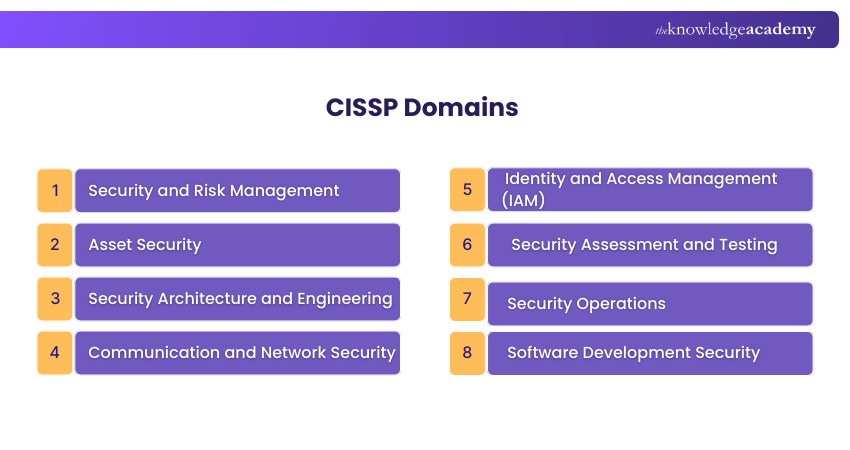
Your experience requirements for CISSP should be within at least two of the eight security domains covered in the CISSP Common Body of Knowledge (CBK). Those domains include the following:
a) Security and Risk Management
b) Asset security
c) Security Architecture and Engineering
d) Communication and Network Security
e) Identity and Access Management (IAM)
f) Security Assessment and Testing
g) Security operations
h) Software Development Security
4) Continuing Professional Education (CPE) Credits
The CISSP certification has a validity of three years, requiring recertification within this period through the accumulation of Continuing Professional Education (CPE) credits. A total of 120 CPE credits is required over the three-year cycle, with 40 CPE credits mandated annually. Failure to meet this requirement necessitates retaking the exam.
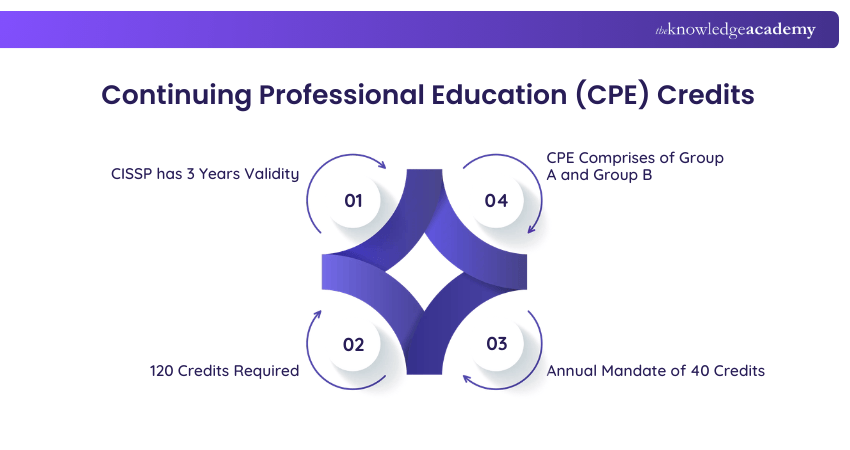
Furthermore, to earn CISSP CPE credits, activities are categorised into Group A and Group B. Recertification entails obtaining 90 Group A CPEs and 30 Group B CPEs.
1) Group A CPEs: They involve activities related to the eight CBK domains beyond normal job duties. These include attending security training, seminars, or workshops, contributing to security publications, and participating in information security activities.
2) Group B CPEs: They include activities outside the eight domains, aimed at enhancing general professional skills and knowledge. Examples include public speaking engagements or management courses.
5) Endorsement Procedure
Upon successfully passing the CISSP exam, certification requires endorsement by an active ISC2 member before becoming official. This endorsement confirms your requisite experience and affirms your ethical and professional conduct.
Advance from security professional to security leader with Chief Information Security Officer Training – Register today!
CISSP Common Body of Knowledge (CBK) - Eight Domains
The CISSP is built around the Common Body of Knowledge (CBK), a framework that defines the eight domains of the certification. These domains cover both Information Security practices and managerial responsibilities, ensuring candidates can protect an organisation from a strategic as well as operational perspective. Let’s now check those domains which are the mandatory CISSP Exam Requirements:
a) Security and Risk Management: Focuses on identifying and managing security risks within an organisation's systems and operations.
b) Asset Security: Concerns safeguarding physical and digital assets, including data protection and asset handling procedures.
c) Security Architecture and Engineering: Involves designing and implementing secure systems and infrastructure to protect against threats.
d) Communication and Network Security: Addresses securing network infrastructure, data transmission, and communication channels to prevent unauthorised access.
e) Identity and Access Management (IAM): Deals with controlling access to systems and data, managing user identities, and enforcing access policies.
f) Security Assessment and Testing: Involves evaluating the security posture of systems through assessments, audits, and penetration testing.
g) Security Operations: Focuses on the day-to-day management of security operations, including incident response, monitoring, and maintaining security controls.
h) Software Development Security: Concerns integrating security into the Software Development Lifecycle to mitigate vulnerabilities and ensure secure coding practices.
Current Update for CISSP Exam
The CISSP Exam is updated to reflect real-world cybersecurity practices. The most recent major update took effect on 15 April 2024 to keep the syllabus aligned with modern Information Security roles and emerging threats. Let's check those updates that comes under CISSP Exam Requirements:
1) Changes in Domain Weightage
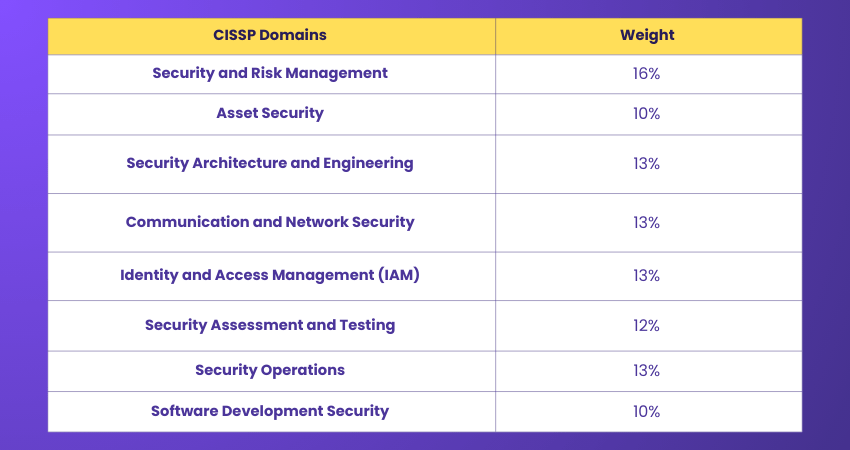
The eight domains of CISSP remain the same, but their weighting was slightly adjusted to match current industry priorities. The weightage of the Security and Risk Management domain has been changed from 15% to 16%, and the weightage of the Software Development Security domain has been reduced from 11% to 10%. The weightage of other domains remains the same with no changes.
Here's a detailed look at the domain weightage:
2) Updated Exam Format
The CISSP Exam now uses Computerised Adaptive Testing (CAT), and the exam timing has been changed from six hours to three hours. You need to answer 100 to 150 multiple-choice and advanced-type questions and have to earn a score of 700 out of 1000 points to pass the exam.
3) Content Updates
The updated CISSP Exam focuses more on real organisational Information Security challenges such as governance, cloud environments, and modern cyber threats. The changes ensure the certification reflects how security professionals actually work today rather than purely theoretical knowledge.
Manage complex Information Security programmes effectively with ISSMP Training – Sign up soon!
What are the Prerequisites for CISSP?
If you want to take the CISSP Exam, here are the prerequisites and CISSP eligibility criteria that you need to know:
1) You need at least five years of full-time, paid work experience in two or more of the eight CISSP domains.
2) A one-year waiver is allowed if you have a bachelor’s or master's degree in related field; or an approved cybersecurity certification recognised by the ISC2.
3) You can also pass the CISSP Exam and become an Associate of ISC2 if you lack experience. After that, you can gain full CISSP certification within six years as an Associate.
What is the Salary of a CISSP Qualified Person?
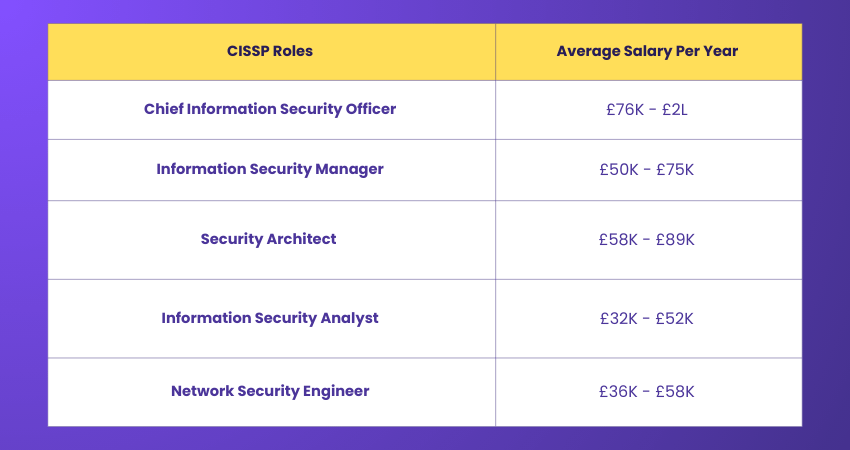
The CISSP qualified professionals earn significantly higher pay than many other IT roles because the certification targets experienced security specialists and leadership positions. However, the salary range can differ based on location, experience, and industry. Let's now check the average annual salary of a CISSP-qualified professionals in different roles in the UK:
Conclusion
In conclusion, navigating the CISSP Exam Requirements requires dedication, expertise, and a continuous commitment to professional development. Achieving CISSP certification not only validates one's proficiency in Information Security but also signifies a dedication to maintaining ethical standards and advancing the cybersecurity field.
Prepare for real-world security challenges with CISSP Courses – Join now!
Frequently Asked Questions
How Many Times Can I Take the CISSP Exam?

You can take the CISSP exam up to four times within 12 months. After the first failed attempt, you must wait 30 days; after the second, 60 days; and after the third, 90 days. If you fail all four attempts, you must wait another 12 months to reapply.
What is the Passing Criteria for CISSP Exam?
To pass the CISSP Exam, you need to score at least 700 out of 1000 on a scaled scoring system that measures performance across all security domains. The Computerised Adaptive Test adjusts question difficulty in real time, and the exam must be completed within three hours.
What are the Other Resources and Offers Provided by The Knowledge Academy?
The Knowledge Academy takes global learning to new heights, offering over 3,000+ online courses across 490+ locations in 190+ countries. This expansive reach ensures accessibility and convenience for learners worldwide.
Alongside our diverse Online Course Catalogue, encompassing 17 major categories, we go the extra mile by providing a plethora of free educational Online Resources like Blogs, eBooks, Interview Questions and Videos. Tailoring learning experiences further, professionals can unlock greater value through a wide range of special discounts, seasonal deals, and Exclusive Offers.
What is The Knowledge Pass, and How Does it Work?
The Knowledge Academy’s Knowledge Pass, a prepaid voucher, adds another layer of flexibility, allowing course bookings over a 12-month period. Join us on a journey where education knows no bounds.
What are the Related Courses and Blogs Provided by The Knowledge Academy?
The Knowledge Academy offers various CISSP Courses, including CISSP Training, ISSMP Training, and Chief Information Security Officer Training. These courses cater to different skill levels, providing comprehensive insights into CISSP Benefits.
Our IT Security & Data Protection Blogs cover a range of topics related to CISSP Exam Requirements, offering valuable resources, best practices, and industry insights. Whether you are a beginner or looking to advance your IT Security & Data Protection skills, The Knowledge Academy's diverse courses and informative blogs have got you covered.

The Knowledge Academy


Global Training Provider
The Knowledge Academy is a world-leading provider of professional training courses, offering globally recognised qualifications across a wide range of subjects. With expert trainers, up-to-date course material, and flexible learning options, we aim to empower professionals and organisations to achieve their goals through continuous learning.

Upcoming IT Security & Data Protection Resources Batches & Dates
Date
 CISSP Training
CISSP Training
Mon 13th Jul 2026
CISSP Training
Mon 10th Aug 2026
CISSP Training
Mon 7th Sep 2026
CISSP Training
Mon 12th Oct 2026
CISSP Training
Mon 9th Nov 2026
CISSP Training
Mon 14th Dec 2026

 If you wish to make any changes to your course, please


