


 Top Rated Course

We may not have the course you’re looking for. If you enquire or give us a call on +44 1344 203 999 and speak to our training experts, we may still be able to help with your training requirements.
What is Neuro Linguistic Programming? A Complete Overview
Charlotte Wilson 14 July 2026Neuro-Linguistic Programming (NLP) is a psychological approach that links brain processes, and behaviour to help achieve personal and professional goals. It focuses on improving communication, mindset, and behavioural patterns for better outcomes. It is widely used in coaching, leadership, and personal development.

Training Outcomes Within Your Budget!
We ensure quality, budget-alignment, and timely delivery by our expert instructors.
Table of Contents
Have you ever wished you could reprogram your thoughts, communicate more effectively, or break free from limiting beliefs? That’s exactly what Neuro-Linguistic Programming (NLP) aims to do! But What is NLP? It’s a fascinating approach that explores the deep connection between language, behaviour, and the mind. By understanding and reshaping these patterns, NLP helps individuals enhance confidence, improve persuasion skills, and achieve personal and professional success.
So, is NLP just a theory? Not at all - it’s a hands-on toolkit used in coaching, therapy, and even business settings to unlock human potential. In this blog, we’ll explore the What is NLP, how it works, and share real-life examples of its application. Let’s get started!
Table of Contents
1) What is Neuro Linguistic Programming?
2) How Does Neuro Linguistic Programming Work?
3) Examples of Neuro Linguistic Programming
4) Does Neuro Linguistic Programming Really Work?
5) How Do You Practice Neuro-Linguistic Programming?
6) What is Neuro Linguistic Programming Therapy Used For?
7) Conclusion
What is Neuro Linguistic Programming?
Neuro-Linguistic Programming is a psychological method that explores how language, thought, and behaviour interact. By understanding how language influences the mind, individuals can reprogram limiting beliefs and improve communication.
NLP is widely used in personal development, coaching, therapy, sales, and leadership. Core techniques include anchoring, mirroring, and the meta-model, which help reshape mindset and enhance interpersonal skills. Key principles involve modelling successful behaviours and reframing negative thoughts to achieve personal and professional growth.
Origins
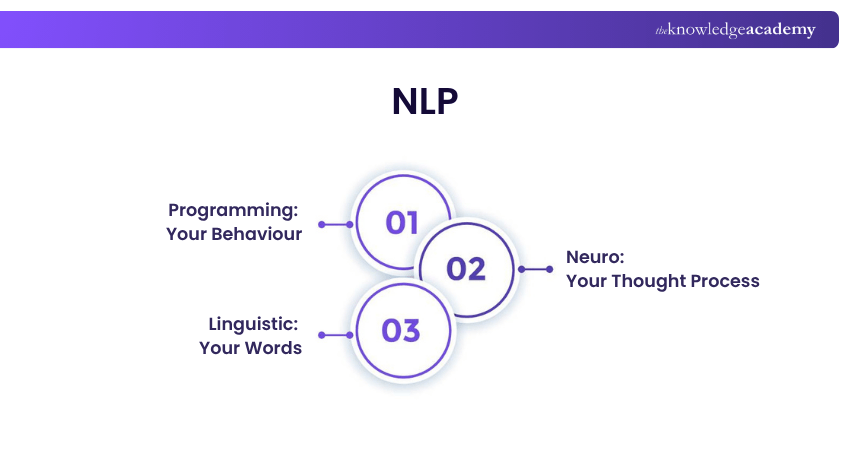
Neuro-Linguistic Programming approach was developed in the 1970s by Richard Bandler and John Grinder. It is based on the idea that thoughts, language, and behaviours are interconnected and can be reprogrammed for personal growth. These key elements were as follows:
a) Neuro
This aspect of NLP focuses on how the brain processes experiences and forms behavioural patterns. It examines how thoughts and emotions influence actions and how they can be reshaped for positive outcomes.
b) Linguistic
Linguistics refers to how language shapes our thoughts, beliefs, and interactions. NLP explores how words influence perception and behaviour, using techniques like reframing and language modelling to enhance communication.
c) Programming
Programming involves modifying thought patterns and behaviours to achieve desired goals. By identifying limiting beliefs and replacing them with empowering ones, NLP helps individuals improve confidence, habits, and overall mindset.

How Does Neuro Linguistic Programming Work?
Here are some other cores Neuro Linguistic Programming techniques:
Reframing
Reframing is an NLP technique that involves changing the way you interpret a situation by looking at it from a different perspective. This helps shift negative thoughts into more positive or useful ones, leading to better emotional responses and behaviour.
Anchoring
Anchoring is a method of linking a specific stimulus, such as a touch, word, or image, to a particular emotional state. Once created, this connection allows you to quickly trigger positive feelings or desired responses when needed.
Modelling
Modelling is the process of observing and copying the behaviours, skills, and thinking patterns of successful people. By understanding how they achieve results, you can apply similar strategies to improve your own performance.
Discover the three main learning styles of NLP with our Neuro Linguistic Programming Course - Register today!
Examples of Neuro Linguistic Programming
NLP has been used extensively in various fields for various purposes. Discussed below are three of the most popular areas where NLP is implemented:
a) NLP is used to develop an individual's personality by improving their confidence, self-reflection, and communication skills.
b) In the domain of business, it has been used to carry out work-related tasks, like increasing a person’s productivity or helping a person advance in a career.
c) NLP is also being used as a form of therapy for various mental health issues such as depression, anxiety disorders, post-traumatic stress disorder, etc.
Learn the details of the human thought process with our NLP Training - join now!
Does Neuro Linguistic Programming Really Work?
It is extremely difficult to determine the effectiveness of NLP as a practice due to its lack of formal regulations. Scientific research on Neuro-Linguistic Programming often has mixed results, making it extremely tough to gauge its effectiveness.
Ethical Criticism of Neuro Linguistic Programming
As NLP grew in popularity over many decades, it also received its fair share of criticism. One of its many ethical criticisms was the lack of a governing body. This raised the potential of people misusing the techniques or even using them with incomplete knowledge, leading to great harm. Like most psychological techniques, NLP has the potential to be abused for personal gains and the emotional manipulations.
Scientific Criticisms of Neuro Linguistic Programming
NLP faces widespread criticism from the scientific community due to its lack of empirical evidence and a solid theoretical foundation. Researchers highlight methodological inconsistencies and exaggerated claims by practitioners. While some individuals report personal benefits, NLP is often considered a pseudoscience because it relies heavily on anecdotal rather than scientific evidence.
How Do You Practice Neuro-Linguistic Programming?
Practising NLP involves techniques like anchoring positive emotions, mirroring body language for rapport, reframing negative thoughts into empowering ones, and using visualisation to reinforce success. These methods help reshape the mindset, boost confidence, and improve communication.
What is Neuro Linguistic Programming Therapy Used For?
NLP therapy is used for overcoming phobias, reducing anxiety, improving self-confidence, and breaking negative behavioural patterns. It helps individuals reprogram limiting beliefs, enhance communication, and develop emotional resilience. NLP is commonly applied in personal development and therapy to support mental well-being and growth.
Conclusion
Neuro-Linguistic Programming offers practical techniques to reshape thought patterns, improve communication, and support personal growth. While its scientific validity remains a topic of debate, it continues to be widely used in coaching, therapy, and development. For those looking to boost confidence or overcome limiting beliefs, understanding What is NLP can be the first step toward meaningful and lasting change.
Try our NLP Foundation and Practitioner Training course to persuade others with your words!
Frequently Asked Questions
What are the Four Types of NLP?

The four types of Neuro-Linguistic Programming are visual, auditory, kinaesthetic, and auditory digital. These represent how people process information through seeing, hearing, feeling, or internal dialogue shaping, communication and behaviour patterns.
What are the 7 levels of NLP?
The 7 levels of NLP, often based on logical levels, include: Environment, Behaviour, Capabilities, Beliefs and Values, Identity, and Purpose (or Spirituality), with some models adding Mission as the seventh level. These levels help understand how thinking and behaviour are structured and how change can be applied effectively.

Charlotte Wilson


Soft Skills and Business Training Manager
Charlotte Wilson is an expert in soft skills development, with over 14 years of experience helping individuals and teams improve communication, productivity and emotional intelligence in the workplace. Her training content is focused on enhancing interpersonal effectiveness and fostering positive, collaborative environments across all levels of an organisation.
View Detail

 If you wish to make any changes to your course, please


